How Do Japanese People View “Foreigners”? Understanding Perceived Distance and Attitudes Through an Awareness Survey
- 1. Do Japanese People Feel Interested in People from Overseas?
- 2. How Have Impressions of People from Overseas Changed?
- 3. What Are the Reasons Behind Changes in Impression?
- 4. How Do Japanese People Feel About an Increase in Foreign Residents in Their Area?
- 5. How Do Japanese People View Overseas Visitors to Japan?
- 6. How Do Japanese People Feel About People from Overseas Working in Japan?
- 7. What Is Considered Important When Working with People from Overseas?
- 8. What Do Japanese People Consider Important When Accepting People from Overseas?
- 9. How Do Japanese People Think About Coexistence with People from Overseas?
- 10. Characteristics of the Japanese Market as Seen Through Japanese Attitudes Toward People from Overseas
As globalization continues to advance, Japanese people are encountering overseas audiences and cultures more frequently than ever before.
With the rise in inbound tourism, international business, and connections formed through social media and digital content, “the global” has become far more familiar than it once was.
However, increased exposure does not necessarily equate to deeper understanding or a stronger sense of closeness.
So what kinds of impressions, emotions, and sense of distance do Japanese consumers actually hold toward people from overseas?
In this survey, we visualized Japanese perceptions of “overseas people” through a series of targeted questions.
The results reveal a nuanced mindset that cannot be explained by simple positivity or negativity—one in which interest and caution coexist at the same time.
Do Japanese People Feel Interested in People from Overseas?

First, we examine what kind of impressions Japanese people have of people from overseas.
Looking at the results, 12.52% responded that they feel “very positive,” while 27.94% answered “relatively positive,” bringing the total share of favorable impressions to 40.46%.
This shows that a certain proportion of Japanese people hold positive impressions of people from overseas.
On the other hand, the most common response was “I don’t have a particularly strong impression,” which accounted for 31.21%.
It is notable that this neutral option—neither positive nor negative—was the most frequently selected.
In addition, 19.46% answered that they have had few points of contact and do not have enough information to make a judgment, while 8.86% said that their impression might improve as they gain more opportunities to learn.
Taken together, these responses indicate that there is a substantial group whose evaluation has not yet been clearly formed.
From these results, it can be said that Japanese attitudes toward people from overseas cannot be explained simply in terms of liking or disliking.
This is because a group with positive impressions and a group that has not yet settled on a clear evaluation coexist.
In particular, the large number of responses such as “I don’t have a particularly strong impression” and “I don’t have enough information to judge” may reflect not negativity toward people from overseas, but rather a situation in which sufficient contact or information has not yet been obtained.
How Have Impressions of People from Overseas Changed?
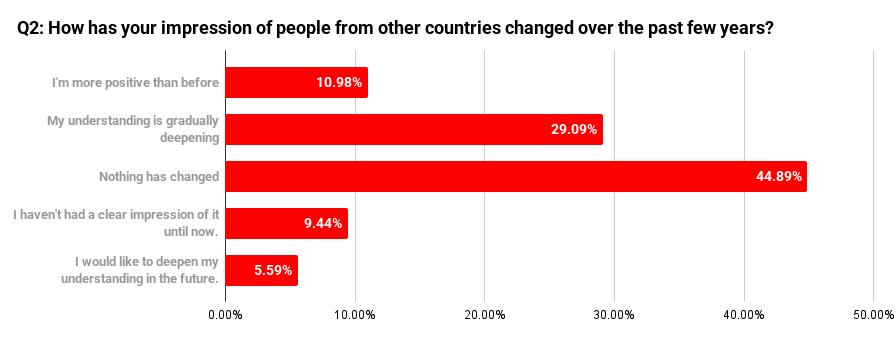
When respondents were asked how their impressions of people from overseas have changed in recent years, the most common answer was “they haven’t changed much,” selected by 44.89% (233 respondents).
The fact that “no change” was the most frequent response suggests that in Japan, perceptions of people from overseas tend to remain relatively stable over time rather than shifting dramatically. In particular, unless there is a strong or defining event, a large segment of the population appears to maintain a sense of continuity or status quo in their impressions.
At the same time, there are signs of gradual movement in a positive direction. “My understanding has gradually deepened” was selected by 29.09% (151 respondents). When combined with “I feel more positive than before” at 10.98% (57 respondents) and “I would like to deepen my understanding going forward” at 5.59% (29 respondents), the total reaches 45.66%.
What is important here is that these changes are not characterized by sudden or dramatic shifts, such as “I suddenly became very positive,” but rather by moderate and incremental changes described as “a deeper understanding.” Rather than having their values fundamentally reshaped through increased contact, Japanese respondents may be experiencing a gradual reduction in uncertainty as the amount of information and exposure slowly increases.
What Are the Reasons Behind Changes in Impression?
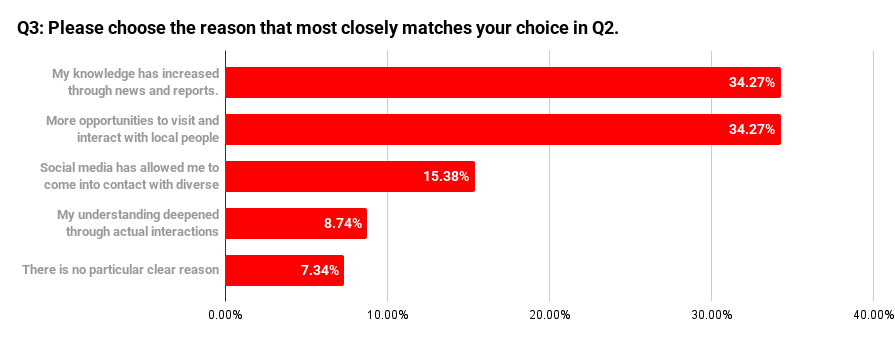
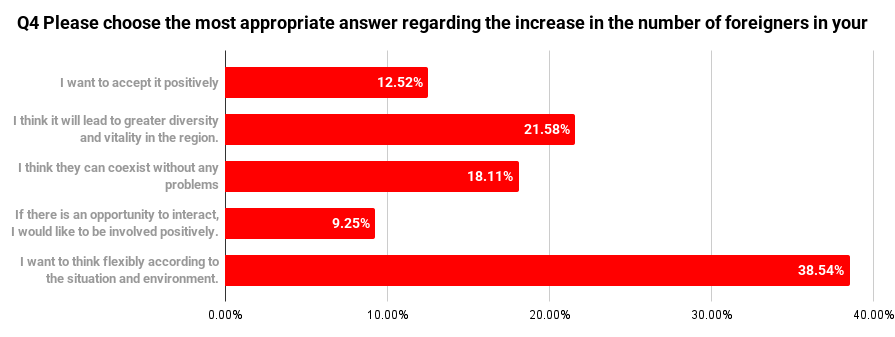
Respondents were asked how they feel about an increase in the number of people from overseas living in their local area.
The most common response was “I would like to consider it flexibly depending on the situation or environment,” selected by 38.54%.
Rather than taking a uniformly positive or negative stance, many respondents prefer to assess the situation on a case-by-case basis.
This was followed by “I think it contributes to diversity and vitality in the community,” at 21.58%, and “I think we can coexist without major problems,” at 18.11%.
These responses indicate that a certain proportion of respondents view an increase in foreign residents in a generally positive light.
In addition, 12.52% answered that they “would like to accept it positively,” while 9.25% selected “I would like to engage positively if there are opportunities for interaction.”
Although levels of enthusiasm vary, strongly negative responses do not dominate the results.
Overall, these findings suggest that attitudes toward an increase in foreign residents are characterized less by clear acceptance or rejection,
and more by a flexible and conditional approach that depends on context and circumstances.
How Do Japanese People Feel About an Increase in Foreign Residents in Their Area?
Respondents were asked how they feel about people from overseas working in Japan.
The most common response was “It depends on the type of job or skills involved,” selected by 33.91%.
Rather than making a blanket judgment, many respondents prefer to evaluate the situation based on the nature of the work and the role involved.
This was followed by “I think it is positive because it brings diverse values,” at 27.36%, and “I don’t particularly see a problem,” at 24.08%.
These results indicate that a considerable number of respondents do not hold strong resistance toward people from overseas working in Japan.
In addition, 9.44% answered that people from overseas should be “actively accepted.”
Although this group is relatively small, it shows that some respondents hold clearly positive views.
By contrast, only 5.20% selected “I think it contributes to revitalizing society as a whole.”
This suggests that relatively few respondents consider broader societal impact when thinking about people from overseas working in Japan.
Overall, the results indicate that attitudes toward people from overseas working in Japan are not defined simply by acceptance or rejection,
but are characterized by a pragmatic and conditional perspective that places importance on roles and circumstances.
How Do Japanese People View Overseas Visitors to Japan?
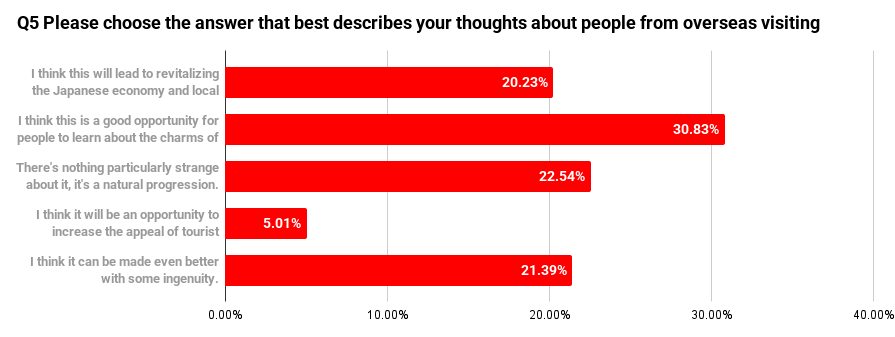
Respondents were asked how they perceive people from overseas visiting Japan.
The most common response was “I think it is a good opportunity for people to learn about the appeal of Japan,” selected by 30.83%.
This indicates that many respondents view inbound visits as a positive opportunity for sharing Japan’s culture and attractions.
This was followed by “I don’t feel any particular discomfort and see it as a natural trend,” at 22.54%, and “With the right measures, it could become an even better situation,” at 21.39%.
These responses suggest a pragmatic acceptance of overseas visitors rather than strong enthusiasm or resistance.
In addition, 20.23% answered that inbound visits “contribute to Japan’s economy and regional revitalization.”
Economic and regional impacts are also being considered by a notable portion of respondents.
By contrast, only 5.01% selected “I think it helps enhance the appeal of tourist destinations.”
This suggests that relatively few respondents focus on specific changes at the level of individual tourist sites.
Overall, the results show that visits by people from overseas are largely perceived as a natural and potentially beneficial development for Japan.
How Do Japanese People Feel About People from Overseas Working in Japan?
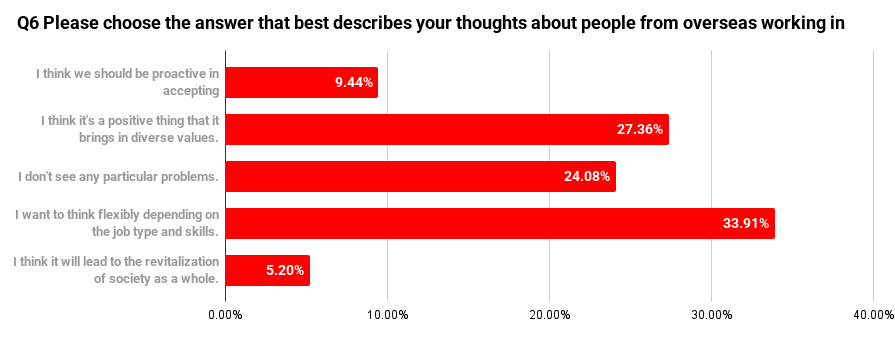
Respondents were asked how they feel about people from overseas working in Japan.
The most common response was “It depends on the type of job or skills involved,” selected by 33.91%.
Rather than making a blanket judgment, many respondents prefer to evaluate the situation based on the nature of the work and the role involved.
This was followed by “I think it is positive because it brings diverse values,” at 27.36%, and “I don’t particularly see a problem,” at 24.08%.
These results indicate that a considerable number of respondents do not hold strong resistance toward people from overseas working in Japan.
In addition, 9.44% answered that people from overseas should be “actively accepted.”
Although this group is relatively small, it shows that some respondents hold clearly positive views.
By contrast, only 5.20% selected “I think it contributes to revitalizing society as a whole.”
This suggests that relatively few respondents consider broader societal impact when thinking about people from overseas working in Japan.
Overall, the results indicate that attitudes toward people from overseas working in Japan are not defined simply by acceptance or rejection,
but are characterized by a pragmatic and conditional perspective that places importance on roles and circumstances.
What Is Considered Important When Working with People from Overseas?
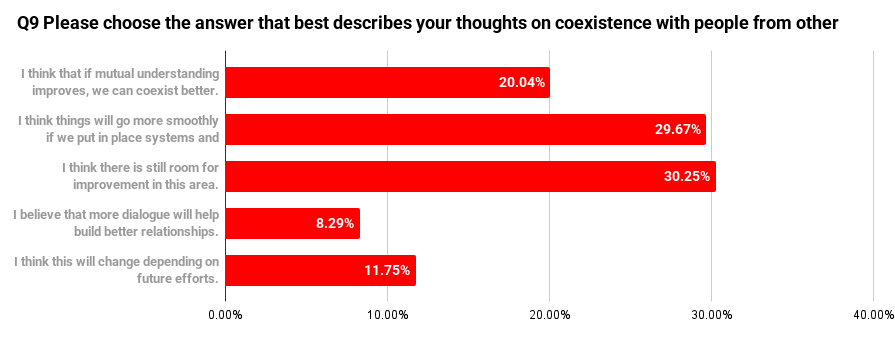
Respondents were asked which view best reflects their thoughts on coexistence with people from overseas.
The most common response was “There is still room for improvement,” selected by 30.25%.
This indicates that many respondents do not see coexistence as something that has already been fully achieved, but rather as an ongoing process.
This was followed by “It would become smoother if systems and rules were better organized,” at 29.67%.
These results suggest a strong awareness that structural frameworks and shared rules play an important role in enabling coexistence.
In addition, 20.04% answered that “better coexistence is possible if mutual understanding progresses.”
A certain number of respondents see dialogue and understanding as key drivers for improving relationships.
Meanwhile, “It depends on future efforts” accounted for 11.75%, and “better relationships can be built through continued dialogue” was selected by 8.29%.
These responses indicate that some respondents have not yet formed a fixed view, but believe outcomes will depend on how efforts develop over time.
Overall, the results suggest that coexistence with people from overseas is perceived not as a completed state,
but as something that needs to be continuously adjusted and improved through rules, systems, and mutual understanding.
What Do Japanese People Consider Important When Accepting People from Overseas?

Respondents were asked what they consider most important when accepting people from overseas.
The most common answer was “understanding Japanese rules and manners,” selected by 39.50%.
This suggests that many respondents place importance on shared norms and basic rules in order to maintain smooth daily life and workplace relationships.
This was followed by “a willingness to respect each other’s culture and customs,” at 29.09%.
Rather than expecting one side to adapt completely, respondents appear to value mutual respect and consideration.
In addition, 17.73% selected “being able to communicate at a basic level.”
This indicates that respondents tend to prioritize basic mutual understanding over advanced language ability.
By contrast, “sincerity toward work or assigned roles” accounted for 7.71%, while “a willingness to build good relationships” was selected by 5.97%.
Compared with attitudes or intentions, fundamental understanding of rules and communication appears to be given higher priority.
Overall, these results suggest that when accepting people from overseas,
Japanese respondents emphasize shared rules and mutual respect as the foundation for building stable relationships.
How Do Japanese People Think About Coexistence with People from Overseas?
Respondents were asked what they consider most important when accepting people from overseas.
The most common answer was “understanding Japanese rules and manners,” selected by 39.50%.
This suggests that many respondents place importance on shared norms and basic rules in order to maintain smooth daily life and workplace relationships.
This was followed by “a willingness to respect each other’s culture and customs,” at 29.09%.
Rather than expecting one side to adapt completely, respondents appear to value mutual respect and consideration.
In addition, 17.73% selected “being able to communicate at a basic level.”
This indicates that respondents tend to prioritize basic mutual understanding over advanced language ability.
By contrast, “sincerity toward work or assigned roles” accounted for 7.71%, while “a willingness to build good relationships” was selected by 5.97%.
Compared with attitudes or intentions, fundamental understanding of rules and communication appears to be given higher priority.
Overall, these results suggest that when accepting people from overseas,
Japanese respondents emphasize shared rules and mutual respect as the foundation for building stable relationships.
Characteristics of the Japanese Market as Seen Through Japanese Attitudes Toward People from Overseas
This survey shows that Japanese attitudes toward people from overseas are not divided simply into positive or negative reactions. Instead, they are shaped while maintaining a cautious sense of distance. Much of the anxiety expressed is directed not at people themselves, but at aspects that feel difficult to fully understand, such as language barriers and cultural differences.
Because of these tendencies, communication in the Japanese market tends to require careful explanation of background and context rather than strong or assertive messaging. For overseas brands and companies, designing strategies that take Japanese ways of perceiving and interpreting information into account is essential.
At hotice, we conduct research and analysis focused on the Japanese market and support the design of marketing initiatives, particularly in influencer marketing. If you are considering an approach tailored to the Japanese market, please feel free to contact us.
.png)