2026 Latest Survey : Report on Instagram Usage Among 534 Japanese Respondents
- 1. How Often Do Japanese People Use Instagram?
- 1-1. Approximately 70% Access at Least Once a Week
- 1-2. Daily Use Among ~60% of Teens and 20s
- 1-3. Over Half of Women Use Instagram Daily
- 2. How Much Time is Spent on Instagram Daily?
- 2-1. Approximately 70% Use the App for Less Than 30 Minutes
- 2-2. “In-depth Viewing” is Also Prevalent Among Teens and Those in Their 20s
- 2-3. Usage Styles: Exploration for Women, Confirmation for Men
- 3. When Is Instagram Most Frequently Used?
- 3-1. Usage Stands Out During Lunch Breaks and Before Bed
- 3-2. Teens Focus on Before Bed, While Those in Their 40s Focus on Lunch Breaks
- 3-3. Gender Differences in How Gap Time is Used
- 4. What Are the Primary Purposes for Using Instagram?
In 2026, Instagram has evolved beyond a simple photo-sharing app into a “Visual Infrastructure” that serves as a primary source of trends and exerts a powerful influence on consumer behavior in Japan. Once a medium centered on younger generations and women, its use has now expanded across all age groups, becoming an indispensable part of daily life.
“How often are Japanese people opening Instagram in 2026?” “How much time are they spending on browsing and posting each day?” “At what moments in their lives do they choose Instagram, and what are they looking for?”
This report provides a deep dive into real-world usage trends based on the latest survey of 534 Japanese individuals conducted in January 2026. The data highlights the current state of Instagram as a platform that deeply resonates with Japanese sensibilities—ranging from filling gaps in free time to searching for information and checking aspired lifestyles.
How Often Do Japanese People Use Instagram?
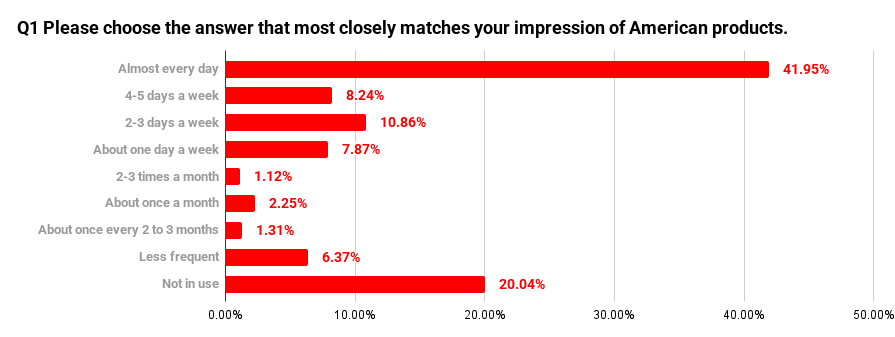
First, we examine how deeply Instagram has integrated into the daily lives of Japanese users by looking at access frequency across different demographics.
Approximately 70% Access at Least Once a Week
The results from 534 respondents reveal that Instagram has become a vital touchpoint for daily information in Japan.
The most common response was “Almost every day” at 41.95% (224 people). When combined with “4–5 days a week” (8.24%), “2–3 days a week” (10.86%), and “About once a week” (7.87%), nearly 69% of Japanese respondents open Instagram at least once a week.
On the other hand, 20.04% (107 people) reported “Do not use.” Other low-frequency users included “Less frequent” (6.37%), “Once a month” (2.25%), and “Once every 2-3 months” (1.31%). These findings underscore Instagram’s role as a significant platform with high consistent engagement in the Japanese lifestyle.
Daily Use Among ~60% of Teens and 20s
Breaking down the data by age highlights a remarkable level of loyalty among Japan’s younger generations.
In the 10s (teens), 61.82% use the app “Almost every day,” followed closely by the 20s at 59.41%. For young people in Japan, Instagram is an essential piece of daily infrastructure. This habit extends to the 30s and 40s, where approximately 40% remain daily users.
While the “Non-user” rate increases with age (31.03% for the 60s and 33.93% for the 70s+), it is noteworthy that 28.57% of those 70 and older still use the app daily. This suggests that visual communication is steadily gaining ground among Japanese seniors.
Over Half of Women Use Instagram Daily
A clear gender gap exists regarding the intensity of usage. 52.53% of Japanese women use Instagram “Almost every day,” compared to 35.71% of men. Women have established a much stronger habit of checking the app as part of their routine.
Furthermore, only 13.64% of women “Do not use” the platform, whereas 23.81% of men are non-users. While popular across both genders, women in Japan engage with the platform more frequently and in a manner more closely tied to their daily lives.
How Much Time is Spent on Instagram Daily?
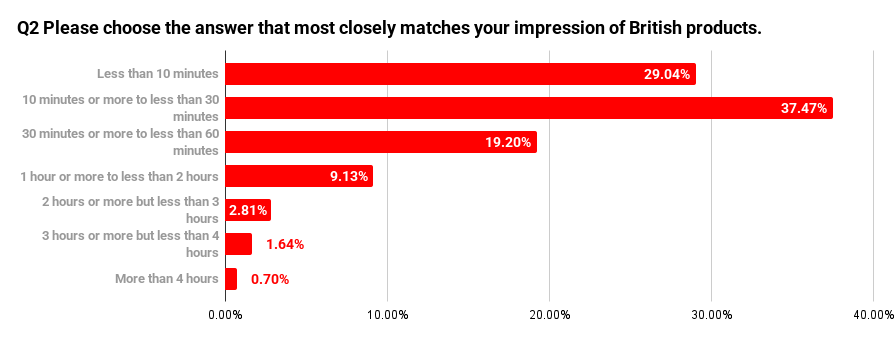
We will organize the depth of engagement by examining how much time Japanese people who use Instagram actually spend on viewing and posting within a single day.
Approximately 70% Use the App for Less Than 30 Minutes
An analysis of responses from 427 Japanese Instagram users reveals that a style of checking information efficiently in a short amount of time has become the mainstream.
The most frequent response was “10 minutes or more to less than 30 minutes” at 37.47% (160 people). This was followed by “Less than 10 minutes” at 29.04% (124 people), showing that these light users who spend less than 30 minutes account for approximately 67% of the total. This clearly reflects the utilization trend among Japanese people to “quickly check” the latest posts and Stories during casual, everyday moments.
On the other hand, “30 minutes or more to less than 60 minutes” was 19.20% (82 people), and “1 hour or more to less than 2 hours” was 9.13% (39 people). The group of long-term users spending 2 hours or more stays at approximately 5% of the total, suggesting that a smart way of engaging with the app by utilizing gap time has become established.
“In-depth Viewing” is Also Prevalent Among Teens and Those in Their 20s
Comparing by age group, the reality has emerged that the younger the generation in Japan, the longer the stay time within the app.
In the 10s age group, those spending “30 minutes or more to less than 60 minutes” account for approximately 30%, significantly exceeding the average across all generations. Additionally, among those in their 20s, a certain number of users spending 1 hour or more can be seen, showing a tendency to consume visual content deeply. For the younger generation in Japan, Instagram holds a strong role not just as a place for checking notifications, but as a place to actively explore topics of interest.
In contrast, among the 50s and older age groups, the compacting of usage time progresses further. Among those 70 and older, “Less than 10 minutes” is the volume zone, and an efficiency-oriented style—where users obtain necessary information at a pinpoint and finish usage in a short time—is common.
Usage Styles: Exploration for Women, Confirmation for Men
Looking by gender, a clear difference was seen in how Japanese men and women approach Instagram.
A characteristic of Japanese women is that the proportion of those spending “30 minutes or more” is higher compared to men. In particular, the percentage of “30 minutes or more to less than 60 minutes” is larger for women; it is inferred that they spend time not only checking posts but also “encountering unknown content” through Reel videos and the Explore tab.
Meanwhile, for Japanese men, the proportion of “Less than 10 minutes” is higher than for women, and short-term, completion-type usage—where they close the app immediately after obtaining the target information—stands out. The result reflects the difference in usage scenes based on gender peculiar to Japanese people: women “enjoy wandering around,” while men “identify and confirm information.”
When Is Instagram Most Frequently Used?
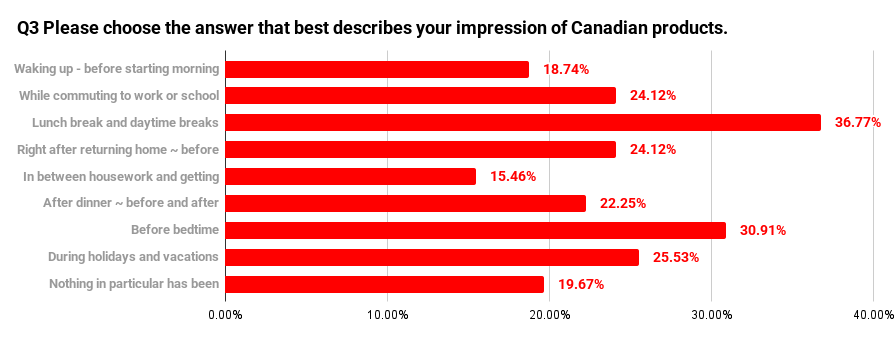
In this section, we will organize the specific usage scenes to see how Instagram is integrated into the daily lifestyle and routines of the Japanese people.
Usage Stands Out During Lunch Breaks and Before Bed
Looking at the responses of the 427 Japanese people who use Instagram, a habit of opening the app at various milestones throughout the day—rather than at one specific time—was observed.
The most common response was “Lunch break / Daytime rest break” at 36.77% (157 people). This was followed by “Before bed” at 30.91% (132 people), showing a trend where usage is concentrated during daytime refreshment periods and relaxation time at the end of the day.
Additionally, “Weekends / Holidays” was also high at 25.53% (109 people), suggesting that users enjoy browsing posts thoroughly during time away from work or studies. On the other hand, “Commuting (to work or school)” and “Immediately after returning home until dinner” both stood at 24.12% (103 people), indicating that the app is frequently checked at timings associated with “relocation,” such as traveling or arriving home.
Teens Focus on Before Bed, While Those in Their 40s Focus on Lunch Breaks
Comparing usage timings by age group, the results vividly reflect the lifestyles of each Japanese generation.
Among teens, the usage rate “Before bed” is the highest across all generations, showing an established style of consuming content during private nighttime hours. On the other hand, among the working Japanese generations in their 40s and 50s, “Lunch break / Daytime rest break” was the most frequent, highlighting the reality that they catch up on the latest information by utilizing limited spare time.
Furthermore, among those aged 60 and older, the percentages of responses for “Weekends / Holidays” and “No specific time decided” were higher than in other generations, suggesting that they utilize the app freely at their own preferred timings without being tied to a specific routine.
Gender Differences in How Gap Time is Used
Looking by gender, clear differences can be seen in the timings when Japanese men and women touch Instagram.
Among Japanese women, in addition to “Before bed,” the response “In between housework or getting ready” tends to be higher than for men. This suggests that Instagram functions as a means of securing “personal time” amidst busy housework or childcare.
Meanwhile, for Japanese men, usage during “Commuting (to work or school)” stands out compared to women. It can be said that the style of actively opening Instagram to fill idle time during travel is a tendency peculiar to men.
A usage pattern aligned with Japanese-specific life rhythms was observed: women utilize it “during gaps in daily life,” while men utilize it at “breaks such as travel or rest.”
What Are the Primary Purposes for Using Instagram?
In this section, we will organize the specific motivations for use to understand what Japanese people are seeking when they open Instagram.
Main Purposes are Killing Time and Enriching Hobbies
An analysis of the responses from 427 Japanese Instagram users reveals a mix of emotional fulfillment and information gathering, rather than just one specific purpose.
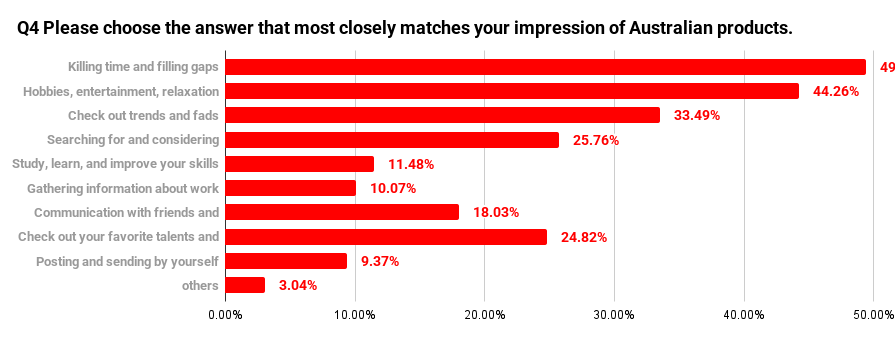
The most common response was “To kill time / Fill gap time,” reaching 49.41% (211 people), showing that approximately half of the Japanese respondents utilize it as a means to fill the margins of their lives. This was followed by “Hobbies, entertainment, and relaxation” at 44.26% (189 people), indicating that the app has become established as a place to find healing by engaging with things they love.
Furthermore, “Checking trends and fashion” at 33.49% (143 people) and “Searching for or considering products and services” at 25.76% (110 people) followed, strongly showing the app’s side as a practical tool that supports catching up on the latest information and making purchasing decisions.
Younger Generations Prioritize Trends, While Those in Their 30s Focus on Utility
Comparing purposes by age group, it is evident that the expected value changes depending on the stage of life.
In the 10s and 20s, the percentage for “Checking trends and fashion” significantly exceeds the average across all generations, reflecting a high sensitivity and a constant search for new information. On the other hand, among those in their 30s, the figures for “Searching for or considering products and services” rise, showing that the app is utilized as a place for specific comparative studies to improve their lives.
Furthermore, among those in their 40s and older, a certain number of users utilize the app for “Study, learning, and skill-up,” suggesting a steady usage style typical of Japan’s middle-aged and older generations, who try to efficiently and visually acquire professional know-how or life hacks.
Women Prioritize Sensibility, While Men Prioritize Information Gathering
A comparison by gender revealed differences in the value sought from Instagram as a medium between Japanese men and women.
Among Japanese women, the percentages for “Checking favorite celebrities/influencers” and “Staying on top of trends” are higher than for men, with a mainstream usage style centered on aspiration and empathy. Meanwhile, Japanese men show a tendency to exceed women in seeking practical and social information, such as “Information gathering for work/business” and “News.”
Although “Killing time” is the most common for both, the difference in utilization styles peculiar to Japanese people was highlighted: women prioritize “stimulating sensibility and connecting,” while men prioritize “gathering necessary information efficiently.”
What Types of Accounts are Followed on Instagram?
In this section, we will organize the trends to understand what types of accounts Japanese Instagram users follow and from whom they continuously obtain information.
Celebrities and Influencers are at the Center of Following
Looking at the responses of 427 Japanese Instagram users, it was found that “individual creators” hold strong influence as follow targets.
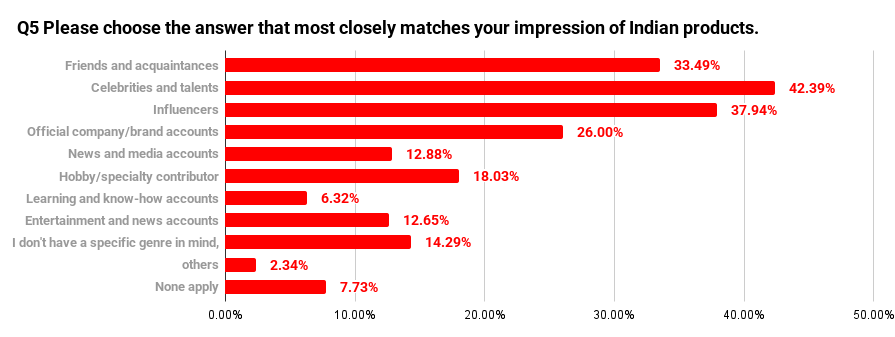
The most frequent response was “Celebrities / Talent” at 42.39% (181 people). This was followed by “Influencers” at 37.94% (162 people) and “Friends / Acquaintances” at 33.49% (143 people). It can be observed that users are not only following the activities of official celebrities but are also balancing connections with social-media-native creators and their own close communities.
Additionally, 26.00% (111 people) of users follow “Official Corporate / Brand Accounts,” showing that one in four people are receptive to information sent out by companies. Other responses included “Specialized / Hobbyist creators” at 18.03% (77 people) and “Often watch posts that flow into the feed without deciding on a specific genre” at 14.29% (61 people).
Strong Trust in Influencers Among the Younger Generation
Comparing follow trends by age group reveals differences in the criteria for “who to follow” across Japanese generations.
Among the younger generation in their 10s and 20s, the percentage of those following “Influencers” reaches approximately 50%, showing a higher figure than any other generation. On the other hand, for Japanese users in their 40s and 50s, “Celebrities / Talent” becomes the volume zone, with a tendency to follow individuals they are familiar with through media such as television.
Furthermore, among those aged 70 and older, the percentage of those following “News / Media accounts” and “Specialized / Hobbyist creators” is higher compared to other generations, highlighting a style of utilizing Instagram as a practical tool for information gathering and exploring hobbies.
Women Prioritize Celebrities, While Men Prioritize News
Looking by gender, different interests between Japanese men and women emerged regarding the types of accounts followed.
Among Japanese women, the percentage of those following “Celebrities / Talent” reaches nearly half at 49.71% (85 people), suggesting that they routinely incorporate the lifestyles of people they admire into their own. Additionally, the follow rate for “Friends / Acquaintances” is higher than for men, showing a tendency to prioritize close communication.
In contrast, a characteristic of Japanese men is that they follow “News / Media accounts” at a higher rate than women. Furthermore, the response “None of the above” reached 10.55% (27 people) for men, compared to 3.51% (6 people) for women, suggesting that a certain number of users exist who enjoy content passively as it flows into their feed without being fixated on specific accounts.

The Current State of Instagram: Stimulating Japanese Sensibilities
Through this survey, it has become clear that for the modern Japanese people, Instagram has transcended the framework of a mere communication tool to become a “core of information gathering” for refining one’s sensibilities and connecting with new worlds. Approximately 40% of all respondents access it every day, and among younger generations and women in particular, it has become deeply established as an indispensable lifestyle infrastructure that adds color to their daily scenery.
From “emotional fulfillment” during gap time to catching up on cutting-edge trends and making intuitive purchasing decisions, the impact that Instagram exerts on the consumption behavior of the Japanese people will only become stronger and more robust in the future.
At hotice, we hold a wealth of proprietary analytical data that quantifies the “worldview construction” and “user empathy levels” unique to Instagram within Japan. We go beyond simple information dissemination; if you are considering a visual strategy that pierces the Japanese sensibility or seeking to utilize influencers who foster deep brand loyalty, please consult with us. With the latest trend data and a professional aesthetic eye, we will fully back your challenge to make your brand an “object of aspiration” in the Japanese market.