2026 Latest Survey : Report on Facebook Usage Among 530 Japanese Respondents
- 1. How Often Do Japanese People Use Facebook?
- 1-1. Approximately 20% Use It Daily, with Nearly 70% Accessing at Least Once a Week
- 1-2. Active Rates for Those in Their 20s and 40s Exceed 20%, Permeating All Generations
- 1-3. 20% of Men Use It Daily, While Women Selectively Use Communities
- 2. How Much Time is Spent on Facebook Daily?
- 2-1. Approximately 72% Spend Less Than 30 Minutes; Short Check-ins Become the Mainstream
- 2-2. Those in Their 20s Explore Deeply, While Middle-Aged and Older Generations Use It Point-to-Point
- 2-3. Women Integrate It into Daily Life, While Men Commit Deeply to Subjects
- 3. When is Facebook Used Most Frequently?
- 3-1. Concentrated Usage During Lunch Breaks and Commutes as Behavioral Transitions
- 3-2. Teens Utilize Nighttime Privacy, While Those in Their 40s Prioritize Daytime
- 3-3. Women Use It Between Chores, While Men Complement Gaps in Public Time
- 4. What Are the Main Purposes for Using Facebook?
- 4-1. Evolving Beyond “Killing Time” into a Tool for Hobbies and Trend Gathering
- 4-2. Younger Generations Refine Sensibilities While Those in Their 30s and Up Use It for Purchasing Decisions
- 4-3. Women Pursue Admiration While Men Prioritize Social Utility
- 5. What Kind of Accounts are Mostly Followed on Facebook?
In 2026, Facebook has evolved into an “infrastructure that guarantees the quality of trust” in the lives of Japanese people.
Our latest in-house survey reveals that approximately 37% of users access the platform more than half the week, highlighting a pragmatic usage style that prioritizes the accuracy of information. The current reality is that it is no longer just a place for status updates; it is being utilized as a different kind of “weapon” by each generation—from trend exploration among those in their 20s to information gathering for the business segment.
In particular, the weight of information backed by real-name authenticity has become a powerful trigger driving modern consumer behavior. This report thoroughly deciphers the new way Japanese people are surviving today’s information society based on the latest data from 530 individuals.
How Often Do Japanese People Use Facebook?
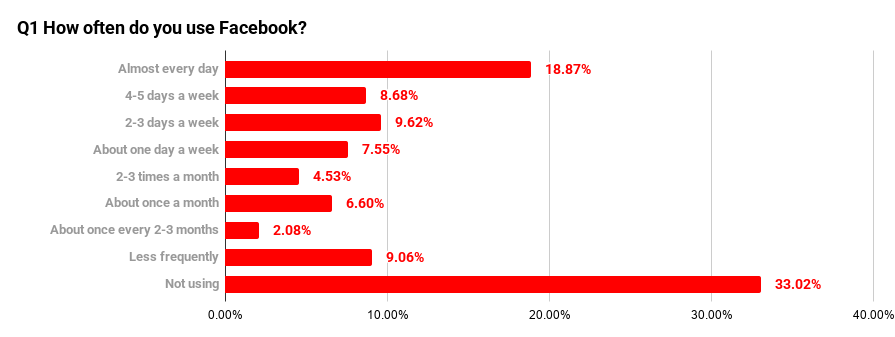
In this in-house survey, we visualized the extent to which Facebook has become established in the current lives of Japanese people, revealing the presence of a persistent active user base.
Approximately 20% Use It Daily, with Nearly 70% Accessing at Least Once a Week
Our latest survey results clarify how Facebook functions as an everyday information touchpoint for a dedicated segment of users. The highest frequency category, “almost every day,” was recorded at 18.87%, highlighting its role as a routine part of daily life.
When totaling users who access the platform at least once a week, the figure reaches approximately 69%. For many Japanese people, Facebook is a medium integrated into their weekly routines. On the other hand, 33.02% of respondents reported “not using” the platform. Compared to other SNS, a major characteristic revealed by this survey is the progressing polarization between the power users who utilize it daily and those who do not touch it at all.
Even in 2026, amid a flood of various SNS, Facebook can be analyzed as a platform that maintains a highly stable contact frequency, making it an indispensable part of life for specific demographics.
Active Rates for Those in Their 20s and 40s Exceed 20%, Permeating All Generations
A detailed analysis of the results by age group shows an interesting structure where a wide range of generations has incorporated Facebook into their lives, rather than usage being biased toward a specific age. Notably, the daily usage rate for those in their 20s (23.76%) and 40s (24.51%) both exceeded 20%, showing a coexistence of trend exploration among the youth and social networking among mid-career professionals.
Respondents in their 30s and 50s also showed that nearly 20% never miss a daily access, suggesting the platform is used as a foundation for both business and private life. While the non-usage rate among seniors aged 70 and older is prominent at approximately 47%, those who do use it maintain a high frequency. Facebook has established its status as a place of trust across generations.
It can be inferred that Facebook’s strength lies in its unique user distribution—where the energy of the younger generation and the insights of the mature generation intersect—a quality not found on other platforms.
20% of Men Use It Daily, While Women Selectively Use Communities
Focusing on usage trends by gender, the data shows that Japanese men are more likely to habitually incorporate Facebook into their daily routines. “Almost daily” usage among men reached 20.63%, surpassing the 16.28% recorded for women. Furthermore, men maintain a higher active rate even when looking at weekly usage.
Among women, the “do not use” response was higher than that of men at 41.40%, indicating a clear distinction in how they use different media. However, female users tend to highly value specific, trusted communities. This highlights a fundamental difference in usage styles: men aim for a comprehensive overview of social information, while women prioritize limited, reliable connections.
These figures vividly illustrate the image of modern users who are not simply swept away by trends, but instead wisely select platforms according to their gender-specific needs.
How Much Time is Spent on Facebook Daily?
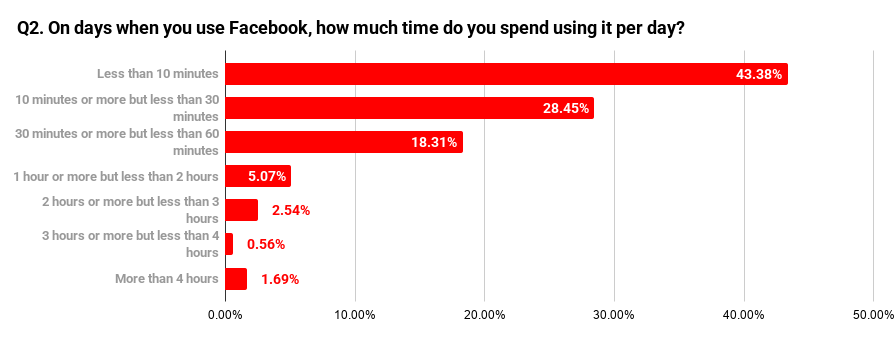
While usage frequency remains high, we examine how the time spent viewing and posting per session is trending, clarifying the specific duration of daily use.
Approximately 72% Spend Less Than 30 Minutes; Short Check-ins Become the Mainstream
A close examination of daily stay times among Facebook users revealed that a style of efficiently checking information is more prevalent than long periods of immersion. The largest response group was “less than 10 minutes” at 43.38%, followed by “between 10 and 30 minutes” at 28.45%.
These “light users” who spend less than 30 minutes account for approximately 72% of the total, showing that the habit of “quickly checking” latest developments during brief moments of daily life has taken root. Rather than forcing deep immersion like video-centric media, Facebook has proven to be a highly efficient tool that seamlessly fits into the gaps of daily routines, providing necessary knowledge quickly.
In terms of the total daily impact, Facebook can be described as a short-duration consumption medium that integrates into the busy daily lives of Japanese people without compromising the freshness of information.
Those in Their 20s Explore Deeply, While Middle-Aged and Older Generations Use It Point-to-Point
A comparative analysis of stay times by generation confirmed an active stance toward information among the younger demographic up to their 20s, who tend to spend more time exploring within the platform. In the 20s age group, more users spend 30 minutes or more compared to the average across all generations, suggesting they devote time to digging into specific topics or engaging in deep interactions within communities.
In contrast, among the mid-career and older demographics from their 40s onward, stay times are becoming even more compact, with a strong trend toward efficiency—exiting the app immediately after obtaining the necessary information. It is highly likely that as users age, the role of Facebook shifts from a “place to stay and enjoy” to an “information filter for quickly grasping the world’s key points.”
This is an interesting result where the value of information and the use of disposable time at each life stage are vividly reflected in the differences in stay duration.
Women Integrate It into Daily Life, While Men Commit Deeply to Subjects
Looking closely at the differences in usage time by gender, subtle variations in how Japanese men and women approach Facebook are reflected. Female users make up the majority of those who finish their usage within 30 minutes, suggesting they skillfully catch up on the latest information between housework or work tasks.
On the other hand, while short-term use is also the primary volume zone for male users, the percentage of those staying for a long duration is higher than that of women, indicating a tendency to track specific discussions. A clear distinction in usage scenarios emerged: while women “smartly incorporate it into their life rhythm,” men devote time to “thoroughly digging into subjects of interest.”
The current reality is that even on the same platform, the methods of filtering information and the ways of immersing oneself in content differ entirely based on gender.
When is Facebook Used Most Frequently?
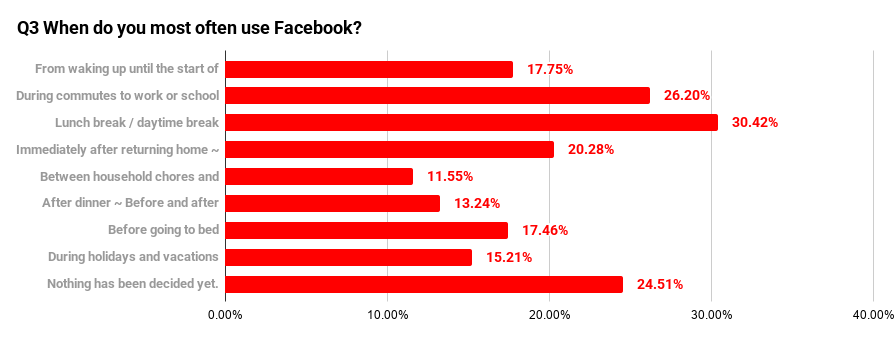
The results of our in-house survey reveal that Facebook usage is not fixed to specific time slots but is instead accessed at various “boundaries” throughout daily life.
Concentrated Usage During Lunch Breaks and Commutes as Behavioral Transitions
A detailed look at the 427 responses from our survey shows that the most common response was “during lunch or daytime breaks” at 30.42%. This was followed by “while commuting” at 26.20%, indicating that usage is concentrated during moments of “movement” or “rest” within active daytime hours.
These data points demonstrate that because Facebook excels in providing immediate information, it is highly compatible with the timing of users wanting to catch up on social movements in a short period. While usage “before bed” (approximately 20%) exists to a certain extent, the reality is that the platform plays a more vital role during hours when users are connected to the “outside world.”
It highlights a habit unique to modern users: opening the app during transitions between “on” and “off” modes to check the latest status of the networks surrounding them.
Teens Utilize Nighttime Privacy, While Those in Their 40s Prioritize Daytime
A detailed comparison of usage timing by age group reveals clear differences in the information consumption rhythms of each life stage. Among teens, the usage rate “before bed” was the highest across all generations, showing an established rhythm of consuming content during calm, private nighttime hours.
In contrast, the prime working-age generation in their 40s showed the highest utilization during “lunch or daytime breaks,” dedicating limited gap time to refreshment and information gathering. For those on the front lines of business, grasping global trends during slight daytime gaps has likely become an indispensable routine.
This vividly reflects the lifestyle differences between generations: while younger users tend to prefer “nighttime immersion,” the working generation prioritizes “daytime efficiency.”
Women Use It Between Chores, While Men Complement Gaps in Public Time
An analysis of contact timing by gender reveals differences in how Facebook is positioned in the daily lives of men and women. For women, usage “before bed” reached nearly half of the group, and the percentage of those opening the app “between housework or getting ready” was higher than that of men, making it a presence that fills small gaps in daily life.
By contrast, men significantly outperformed women in usage “while commuting” and during “lunch breaks,” actively checking the app to resolve boredom while away from home. The style of trying to fill the voids of public time—such as travel—with social connections and news checks appears to be a male-specific trend.
The data indicates a gender-based gap in consciousness: women utilize Facebook as a “personal window within daily routines,” while men use it to fill “voids in public time.”
What Are the Main Purposes for Using Facebook?
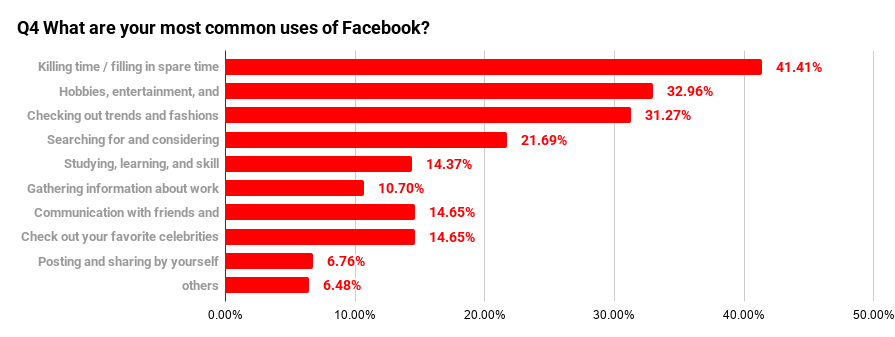
Our data reveals that the motivations for opening Facebook go beyond mere “killing time,” encompassing multi-layered needs for catching up on personal hobbies and social trends.
Evolving Beyond “Killing Time” into a Tool for Hobbies and Trend Gathering
A detailed analysis of usage purposes shows that the most common response was “killing time / filling gap time” at 41.41%, with about 40% of users utilizing it to fill the voids in their daily lives. This was followed by “hobbies, entertainment, and relaxation” at 32.96% and “checking trends and fads” at 31.27%, highlighting a clear stance of accessing the platform for the freshness and quality of information.
Furthermore, approximately one in four users aims for “communication with friends and acquaintances,” opening the app in search of unique connections backed by real-name reliability. The current reality is that while entertainment remains a core pillar, Facebook is being used diversely and practically as a “personal information base” to deepen one’s own interests.
This in-house survey highlights its function not just as a place for browsing, but as a “knowledge hub” for enriching one’s own lifestyle.
Younger Generations Refine Sensibilities While Those in Their 30s and Up Use It for Purchasing Decisions
Comparing usage purposes by age group shows a prominent shift in the value expected from Facebook—from “stimulation” to “utility”—depending on one’s life stage. Among the younger demographic up to their 20s, the percentage of “checking trends and fads” significantly exceeded the all-generation average, reflecting a desire to refine their sensibilities by constantly staying in touch with new information.
On the other hand, in the 30s and 40s age groups, a certain number of users utilize the platform for “searching for or considering products and services,” functioning as a space for comparative studies directly linked to real life. Rather than highly anonymous reviews, the weight of information on Facebook, where “who is sending the information” is clear, appears to be a powerful trigger supporting the decision-making of modern consumers.
This survey reveals a strategic split by generation: while younger users seek to update their sensibilities, the mid-career demographic and above weaponize the reliability of information.
Women Pursue Admiration While Men Prioritize Social Utility
The analysis of differences in purpose by gender provides data showing a clear directional gap in the benefits sought from the medium. Japanese women have a higher percentage of “checking favorite celebrities or influencers” and “hobbies/relaxation” compared to men, with usage centered on emotional engagement driven by empathy and admiration.
In contrast, Japanese men tend to surpass women in seeking practical and social information, such as “gathering information for work or business” and “news.” The rational and functional usage style—quickly grasping objective global trends and applying them to one’s own business or judgment—appears to be a male-specific trend.
The results vividly reflect an essential difference in utilization based on gender: women prioritize “resonance with favorites,” while men prioritize “information coverage and utility.”
What Kind of Accounts are Mostly Followed on Facebook?
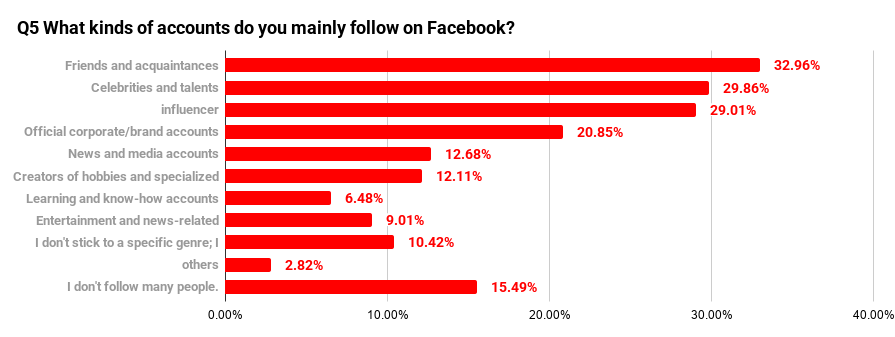
Through an analysis of following behavior, we decipher the intentions of users and how they aim to construct their own timelines as a personalized information space.
Centered on Friends, While 30% Also Support Celebrities and Creators
Our in-house survey confirming follow targets revealed that “Friends and Acquaintances”—the original core of the platform—was the most common response at 32.96%. This was followed by “Celebrities/Personalities” at 29.86% and “Influencers” at 29.01%, showing the immense influence held by individual creators.
While following the movements of official public figures, the expertise and passion of SNS-native creators maintain a significant presence in user timelines. Additionally, 22.11% of users follow “Official Corporate/Brand Accounts,” meaning approximately one in four users receives information directly from companies.
Following behavior on Facebook can be described as the construction of personal media, where users expand their own interests and ensure the reliability of information through the persona of the sender.
Younger Generations Trust Passion, While Seniors Select Experts
Analyzing following trends by age group reveals that the “source of trust” for obtaining information differs dramatically by generation. Among the younger demographic aged 20 and under, the follow rate for “Influencers” was the highest across all generations, indicating they view SNS-born stars as having influence equal to or greater than television personalities.
On the other hand, in the 40s and 50s age groups, there is a stronger tendency to prioritize “News/Media Outlets” and “Hobby/Specialized Field Creators” in addition to celebrities. Based on their own long-cultivated aesthetic eye, these mature users make steady choices, prioritizing the accuracy and expertise of information.
A clear distinction in trust standards emerged: the younger generation is drawn to “individual passion,” while middle-aged and older generations prioritize “certainty and expertise.”
Men Capture Official Information, While Women Connect Through Empathy
A comparison of following criteria by gender revealed different priorities in the values underlying account selection between Japanese men and women. Japanese women follow “Celebrities/Personalities” and “Friends/Acquaintances” at a higher rate than men, emphasizing connections based on empathy or a sense of familiarity with specific individuals.
In contrast, Japanese men tend to surpass women in following “News/Media Outlets” and “Official Corporate Accounts.” Rather than being attached to a specific individual, a style that prioritizes objectivity—aiming to comprehensively acquire social movements and new product information—appears to be a male-specific trend.
The data reflects an essential difference in SNS utilization: women find motivation in “resonance with people,” while men find it in “utility and the coverage of information.”
Conclusion
Through this in-house survey, it has become clear that as of 2026, Facebook has been redefined as an “infrastructure that guarantees the quality of trust” in the lives of Japanese people.
With approximately 37% of users accessing the platform more than half the week and a style of efficiently consuming information within 30 minutes per day, this can be described as a sophisticated method of information gathering in modern society. The generational distinction in information usage is particularly striking: younger users respond to the passion of influencers, while the middle-aged and older demographics weaponize the insights of experts.
Furthermore, the differences in usage scenarios by gender have become vivid. While women color the gaps in their daily lives through empathy and admiration, men prioritize functional usage—comprehensively gathering social information during public idle time, such as commutes, and linking it to practical benefits.
We remain committed to capturing these deep-seated user behaviors and will continue to fully support the creation of valuable connections.