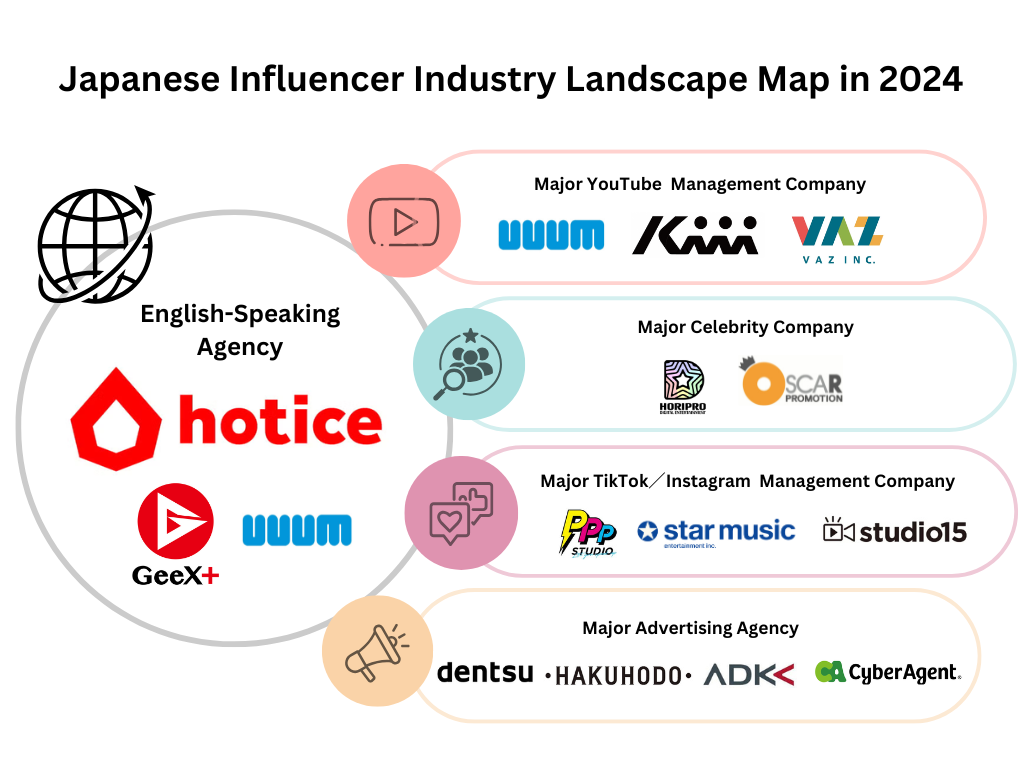
Japanese Influencer Industry Landscape Map in 2024
- 1. The Map: Seven Player Types
- 2. 1. Advertising Holding Groups
- 3. 2. YouTube-Centric Management Companies
- 4. 3. Short-Form Specialists: TikTok, Reels, and Shorts
- 5. 4. Traditional Talent Agencies
- 6. 5. Independent Casting Agencies
- 7. 6. Platform and Tool Vendors
- 8. 7. Cross-Border Agencies
- 9. What Changed Since the 2024 Map
- 10. How to Choose Which Door to Knock On
- 11. FAQ
- 11-1. What is a chaos map in the Japanese market context?
- 11-2. Which is the largest influencer agency in Japan?
- 11-3. Should an overseas brand work with a Japanese agency or an international one?
- 11-4. Why do Japanese agencies mostly propose their own creators?
- 11-5. Do I need an agency at all, or can I contact creators directly?
- 11-6. Can I reuse this map?
- 12. Work With hotice
TL;DR: Japan’s influencer industry divides into seven player types: advertising holding groups, YouTube-centric management companies, short-form specialists, traditional talent agencies, independent casting agencies, platform and tool vendors, and cross-border agencies. Which type you approach determines whether you get a curated shortlist or a roster pitch. Since 2024 the market has consolidated, and short-form has become the fastest-growing segment.
Overseas brands approaching Japan usually discover the same thing: there are a lot of companies offering influencer marketing, they describe themselves in almost identical language, and it is unclear which type of company does what. That confusion has a cost, because the category a company belongs to predicts how it will behave far better than its sales deck does. A YouTube management company will propose its own creators. An independent casting agency will propose across the market. Neither is wrong, but they answer different questions.
This is a map of the Japanese influencer industry as it stands in 2026, organised by player type rather than by company size. Each section covers what that type of company does, how it makes money, when it is the right partner, and the trade-off you accept by choosing it. The final sections cover what has changed since the 2024 version of this map and how to decide which door to knock on.
hotice is a cross-border influencer marketing company that helps overseas brands enter the Japanese and wider Asian markets, with campaign experience for brands such as Turtle Beach and Clinique. We sit in the cross-border category described below, and we work with companies across the other six. Book a free consultation.
The Map: Seven Player Types
Start here. The right partner depends on what you need decided for you and what you want to keep control of.
| Player type | What they do | Best when | The trade-off |
|---|---|---|---|
| Advertising holding groups | Full campaign planning with influencer work as one component, usually subcontracted | Large integrated campaigns across TV, digital, and creators | High minimums, and creator selection often sits with a subcontractor you do not meet |
| YouTube-centric management | Exclusive management of long-form creators, sold as packages | You want a specific YouTuber, or long-form demonstration at scale | Proposals are limited to their own roster |
| Short-form specialists | TikTok, Reels, and Shorts creators, often in large volume | Youth-facing campaigns and vertical video at volume | Short content lifespan, and reach can be shallow per creator |
| Traditional talent agencies | TV talent, models, and actors, increasingly with social channels | Campaigns needing mainstream credibility or a recognisable face | Higher fees, longer approvals, and stricter usage terms |
| Independent casting agencies | Cast across the whole market rather than a fixed roster | You want the best fit rather than the available fit | Coordination is more complex because several counterparties are involved |
| Platform and tool vendors | Software for discovery, campaign management, and measurement | You have an in-house Japanese team running campaigns | The tool does not negotiate, brief, or handle compliance |
| Cross-border agencies | Serve overseas brands in their own language and manage the Japanese side | You are entering Japan without a local team | Fewer such companies exist, so availability is the constraint |
Pricing, past campaigns, and how contracts and ad-disclosure compliance are handled from start to finish. Ask us anything before you commit to a budget.
Overseas brands welcome. We work in English, Japanese, Chinese, and Korean.1. Advertising Holding Groups
Japan’s advertising market is unusually concentrated, and the large agency groups, Dentsu, Hakuhodo, CyberAgent, and ADK among them, sit at the top of it. They control large client budgets and handle influencer work as one line inside a broader campaign.
The structural point overseas brands should understand is that these groups usually do not hold creator relationships directly. They subcontract to influencer companies, which means the creator shortlist you receive has already been filtered by whoever holds the subcontract, and that party has an incentive to propose creators it manages. That is not misconduct, it is how the layer works, but it does mean the shortlist is not a market-wide search.
Approach this layer when influencer work is genuinely one component of an integrated campaign with television or large-scale paid media attached. For a creator-only campaign, you are paying for coordination you do not need.
2. YouTube-Centric Management Companies
YouTube carries more weight in Japan than in most markets, reaching 80.8% of the population, and the companies managing long-form creators became the first recognisable influencer businesses here. UUUM is the largest, co-founded with HIKAKIN, and Kiii and BitStar are among the other established names.
This part of the map changed materially in 2024. FreakOut Holdings completed a tender offer for UUUM in December 2024, taking full ownership and delisting the company from the Tokyo Stock Exchange Growth Market. The stated rationale was integrating the group’s influencer marketing operations. Read alongside the wider pattern of consolidation in the sector, the signal is that standalone creator management is a harder business than it looked in the 2010s, and that management companies are being absorbed into groups with advertising technology attached.
For brands, the practical characteristic of this layer is that proposals come from the roster. If the creator you want is managed here, this is where you go. If you want the best fit in a category, a roster-based proposal will show you the best fit that happens to be under contract with that company.
3. Short-Form Specialists: TikTok, Reels, and Shorts
Short-form vertical video is the fastest-growing segment of the Japanese influencer market, at 24.6 billion yen in 2024, up 37% year on year, against 16% growth for influencer marketing as a whole. Source: CyberBuzz and Digital InFact, November 2024 (cyberbuzz.co.jp).
Companies specialising here manage creators at higher volume than the YouTube layer, because short-form economics work differently: individual posts cost less, campaigns use more creators, and content turnover is faster. PPP STUDIO and Studio15 are among the established TikTok-focused names, and newer companies such as Natee have built businesses specifically around short video.
The trade-off is durability. A short-form post reaches its audience quickly and then stops, whereas a YouTube review keeps being found through search for months or years. Campaigns that need long-tail discovery should not be built entirely on this layer.
Not sure whether your campaign belongs in the long-form or short-form layer? The answer usually comes from how much explanation your product needs before someone buys it. Tell us your category and we will tell you which layer to approach and why. Get a recommendation.
4. Traditional Talent Agencies
Japan’s established entertainment agencies, which manage television talent, actors, and models, have moved into influencer work as their talent built social followings. Horipro and Oscar Promotion are long-standing examples, and several groups now run dedicated digital divisions for this business.
What this layer offers is mainstream credibility. A recognisable television face carries a kind of legitimacy across age groups that a platform-native creator does not, which matters for categories where trust is the main barrier. What it costs is flexibility: fees are higher, approval chains are longer, usage rights are tightly defined, and secondary use is negotiated carefully.
For overseas brands the practical note is timeline. Talent agency approvals in Japan run on relationship terms and a fixed process, so a campaign involving established talent needs to be scoped months rather than weeks ahead.
5. Independent Casting Agencies
A large share of Japanese creators are not exclusively managed. Independent casting agencies work across that population, plus managed creators through agency relationships, and their proposal is a shortlist assembled for the brief rather than drawn from a roster. Tagpic and W TOKYO are established names, and companies such as Trenders and SocialWire operate in the same broad space.
This is the layer where casting quality varies most, because the value is entirely in the selection process rather than in the roster. The useful questions to ask are how creators are screened, whether engagement quality and audience overlap are examined or only follower counts, and whether the agency will show you creators it does not have a commercial relationship with. Our guide on how to find and vet Japanese influencers sets out the screening criteria in order of predictive value.
6. Platform and Tool Vendors
A growing group of companies sells software rather than service: creator databases, campaign management, and measurement tools. These are useful if you already have a Japanese-speaking team that can brief, negotiate, and review content.
The gap to be aware of is that a tool surfaces creators but does not do the parts that most often go wrong. In our survey of 102 Japanese companies, the most frequently cited difficulty was creators not understanding the product, at 42.9%, which is a briefing problem no database solves. Our review of influencer marketing tools in Japan covers what the main platforms do and where the boundary sits.
7. Cross-Border Agencies
The smallest category, and the one that exists because of a structural gap: English-speaking staff remain relatively scarce across Japanese agencies, and Japanese talent agencies largely operate in Japanese and on relationship terms. Email outreach in English frequently goes unanswered, which overseas teams tend to read as disinterest when it is usually a process mismatch.
Companies in this category work with the overseas brand in its own language while running the Japanese side natively. hotice sits here, with a bilingual team working in English, Japanese, Chinese, and Korean. GeeXPlus manages Japan-based creators who work in English, concentrated in gaming, and UUUM has some English-speaking capability at the scale of a large management company.
The reason this category matters more than its size suggests is that everything downstream of casting runs in Japanese: negotiation, contracting, briefing, disclosure compliance, and pre-publication review. A brand without that layer either builds it internally or accepts that each of those steps moves at the speed of translation.
hotice is a cross-border influencer marketing agency helping overseas brands enter Japan. We handle casting, negotiation, Japanese-language contracts, and ad-disclosure compliance.
Tell us your category, budget range, and timing. We will take it from there.What Changed Since the 2024 Map
Four shifts are worth noting if you last looked at this market a couple of years ago.
| Shift | What happened | What it means for a brand |
|---|---|---|
| Consolidation | FreakOut Holdings took full ownership of UUUM in December 2024 and delisted it, continuing a pattern of management companies being absorbed into larger groups | Fewer independent counterparties at the top of the market, and more integration between creator management and ad technology |
| Short-form overtook long-form in growth | Short-form vertical video grew 37% in 2024 against 16% for the category | The short-form layer has more supply and more competition for the best creators than it did in 2024 |
| Disclosure became a legal obligation | Undisclosed paid promotion has been a designated unfair representation since October 2023, with liability on the advertiser | Compliance capability is now a genuine differentiator between partners rather than a formality |
| Adoption broadened, budgets did not | In our survey of 102 companies, nearly all had run influencer campaigns but fewer than 10% spent above one million yen per campaign | A well-funded, properly structured campaign faces less competent competition than the participation rate suggests |
Sources: CyberBuzz and Digital InFact, November 2024, and hotice and RASA JAPAN survey of 102 Japanese companies, June 2025.
How to Choose Which Door to Knock On
Four questions resolve most of the decision.
- Do you already know which creator you want? If yes, go to whoever manages them. If no, a roster-based partner will narrow your options before you see them.
- Does your product need explaining? Long-form and the YouTube layer for considered purchases, short-form for products that are understood at a glance.
- Do you have a Japanese-speaking team? If not, the cross-border layer is not a preference, it is the thing that makes the other six usable.
- Is influencer work standalone or part of an integrated campaign? Integrated campaigns justify the holding group layer. Standalone campaigns rarely do.
If you are still deciding whether to work with an agency at all, our comparison of influencer marketing agencies in Japan goes through the selection criteria and what each type of partner charges.
FAQ
What is a chaos map in the Japanese market context?
A chaos map is a Japanese business convention for a single-page diagram that groups all the companies in an industry by category. They are widely used in Japan to make crowded markets legible. This page is the written equivalent for the influencer industry, organised by player type rather than by company.
Which is the largest influencer agency in Japan?
UUUM remains the largest creator management company by roster scale. Since December 2024 it has been a wholly owned subsidiary of FreakOut Holdings following a tender offer, and it is no longer listed. Size and suitability are different questions, though: the largest roster is not the same as the best fit for a specific brief.
Should an overseas brand work with a Japanese agency or an international one?
The useful distinction is not nationality but whether the partner can operate natively on both sides. Casting, negotiation, contracting, and disclosure review all happen in Japanese, while your briefing, approvals, and reporting happen in your own language. A partner that covers both removes the translation step from every one of those handoffs.
Why do Japanese agencies mostly propose their own creators?
Because management companies earn from their roster. It is a structural incentive rather than a failing, and it is why the category a company belongs to is worth establishing before the first meeting. If you want a market-wide search, ask an independent casting agency and ask directly whether they will propose creators they do not manage.
Do I need an agency at all, or can I contact creators directly?
Direct contact is possible with independent creators, and some brands do it. What you take on is Japanese-language negotiation, contract terms covering usage and secondary rights, disclosure compliance where liability sits with you as the advertiser, and the briefing work that our survey identifies as the most common failure point. Direct contact saves a fee and adds an operation.
Can I reuse this map?
Yes. The categorisation and the data on this page may be cited or reproduced with attribution and a link. If you need a version for a presentation or a report, get in touch and we will provide one.
Work With hotice
hotice works across the categories described above. We maintain relationships with management companies, talent agencies, and independent creators, which means we can cast from the market rather than from a fixed roster, and we run the Japanese side of the process end to end: negotiation, contracting, briefing, disclosure compliance, and reporting.
Tell us your category, target audience, and what you are trying to achieve in Japan, and we will tell you which part of this map fits and what working with it involves.
Supervised by the hotice Editorial Team, specialists in helping global brands enter the Japanese and Asian markets through influencer marketing. Last updated: July 2026.
Pricing, past campaigns, and how contracts and ad-disclosure compliance are handled from start to finish. Ask us anything before you commit to a budget.
Overseas brands welcome. We work in English, Japanese, Chinese, and Korean.