2026 Latest Survey : Report on Threads Usage Among 536 Japanese Respondents
- 1. How Often Do Japanese People Use Threads?
- 1-1. Approximately 20% Use It Daily
- 1-2. Approximately 30% of Those in Their 20s Use It Daily
- 1-3. Approximately 24% of Women Use It Daily
- 2. How Much Time is Spent on Threads Daily?
- 2-1. 70% of Users Spend Less Than 30 Minutes
- 2-2. About 40% of Those in Their 20s Stay for Over 30 Minutes
- 2-3. Men for Long Sessions, Women for Gap Time
- 3. When is Threads Used Most Frequently?
- 3-1. Established as a Daytime Refreshment
- 3-2. Those in Their 40s Focus Usage During Lunch Breaks
- 3-3. Women Use It Before Bed, Men Use It While Commuting
- 4. What Are the Main Purposes for Using Threads?
In 2026, Threads is gradually becoming recognized as an “informational third place” in the daily lives of Japanese people. Our latest in-house survey reveals that approximately 20% of users access the platform every day, proving that a new form of text-based connection has seamlessly integrated into their lifestyles.
The current reality is that Threads is no longer just an emerging SNS; it has undergone its own unique evolution, characterized by a high retention rate—with about 30% of those in their 20s using it daily—and empathy-driven communication centered around female users. In particular, the smart consumption of information during gap time and a structure where personal credibility generates value have become new triggers driving modern consumer behavior.
This report deciphers the actual state of Threads usage in 2026 based on the latest data from 536 Japanese individuals. Through various figures where efficiency and sensibility intersect, we will present a detailed analysis of the new way Japanese people lightheartedly navigate today’s information society.
How Often Do Japanese People Use Threads?
To what extent has Threads permeated the daily lives of Japanese people, and how frequently is it accessed? We examine the reality of how this new text-based trend is integrated into modern lifestyles, broken down by user demographics.
Approximately 20% Use It Daily
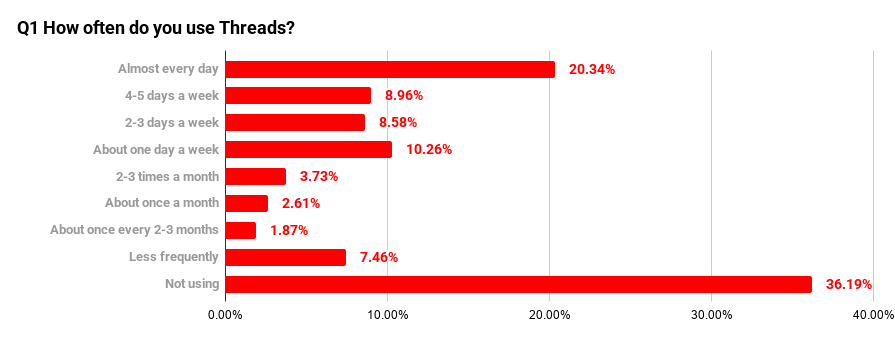
An analysis of the 536 respondents in this survey reveals that Threads is being utilized as a daily tool by a specific, enthusiastic segment of users. The most notable finding is that 20.34% (109 people) responded that they use it “almost every day,” indicating that approximately one in five people has become a settled daily user.
On the other hand, 36.19% (194 people) responded that they “do not use it,” showing that the platform is still in a stage where there is room for further expansion. However, when totaling those who access the app at least once a week, the figure reaches approximately 48%. For nearly half of the Japanese population, Threads has become one of their primary options for information.
Threads maintains a unique sense of distance compared to past text-based SNS. Rather than being a tool opened only occasionally, it is increasingly becoming a “resident-type media” accessed for specific purposes or communities. This serves as evidence that the platform is steadily carving out a place in daily life amidst the accelerating pace of information filtering.
Approximately 30% of Those in Their 20s Use It Daily
Looking at the data by age group, the active usage among the younger generation—centered on those in their 20s—is clearly reflected in the numbers. For those in their 20s, the percentage of “almost daily” users reached 28.71% (29 people), the highest across all generations, making it an indispensable platform for this trend-sensitive group.
Even among those in their 30s (20.95%) and 40s (22.86%), more than 20% access the app daily, functioning as a space to update both business and private information. While daily usage among those aged 70 and older remains at 10.91%, it is not a case of total non-usage; rather, the platform appears to be gradually spreading across all generations.
While the younger demographic uses it as an “informational breathing space,” it can be inferred that the mid-career demographic is seeking new connections and insights not found on existing SNS. Although the speed of adoption varies by generation, the current reality is that Threads is establishing its status as a piece of “lifestyle infrastructure,” particularly for those in their 20s.
Approximately 24% of Women Use It Daily
In a comparison by gender, while both men and women maintain a certain level of usage, a clear trend emerged showing that Japanese women use Threads more habitually. “Almost daily” usage among women reached 24.22% (47 people), significantly outpacing the 17.57% (60 people) recorded for men.
Regarding the “do not use” response, there is a gap of more than 12 percentage points—28.35% for women versus 40.52% for men—suggesting that women have a higher receptivity to the platform. It can be inferred that while men tend to prioritize breaking news and practical benefits, women seek communication centered on empathy and casual daily sharing on Threads.
Pricing, past campaigns, and how contracts and ad-disclosure compliance are handled from start to finish. Ask us anything before you commit to a budget.
Overseas brands welcome. We work in English, Japanese, Chinese, and Korean.This suggests that for Japanese women in particular, Threads plays a strong role as a “third place” where they can comfortably consume information within the flow of their daily lives. This survey highlights that an emotionally resonant user experience is a key factor supporting the strong backing from female users.
How Much Time is Spent on Threads Daily?
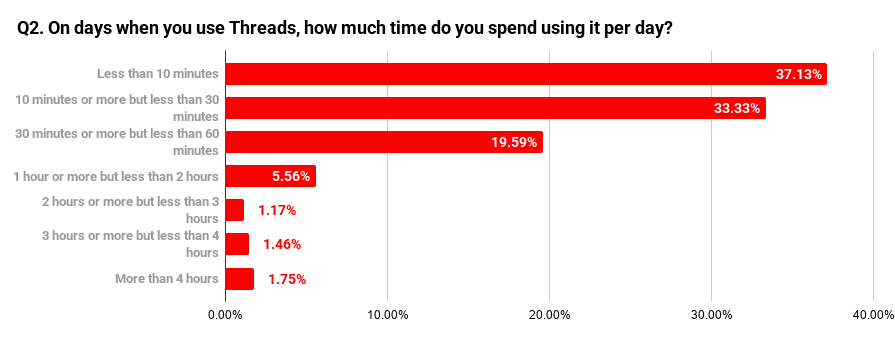
We analyze how much time users actually spend on Threads within their daily routines to understand the depth of their engagement. In an era where being “always-on” is the norm, let’s look at the detailed reality of the intensity with which users interact with the platform during each session.
70% of Users Spend Less Than 30 Minutes
An analysis of 342 responses regarding usage time revealed that a style of “short sessions and efficient information consumption” is the mainstream. The highest percentage was 37.13% (127 people) for “less than 10 minutes,” followed by 33.33% (114 people) for “between 10 and 30 minutes.”
Combined, approximately 70% of users keep their daily usage within 30 minutes, showing that a “smart engagement style” utilizing gap time has taken root. Rather than assuming long periods of immersion like video-based media, there is a prominent trend of high-frequency, short-duration consumption—quickly scrolling through the timeline to check what is happening “now.”
The data highlights that Threads is a medium that integrates into the busy daily lives of Japanese people without losing the freshness of information. Rather than a deep, transient immersion, the core value of Threads appears to lie in the frequency with which users check the “atmosphere of the world” across various scenes of daily life.
About 40% of Those in Their 20s Stay for Over 30 Minutes
Comparing stay times by age group reveals that younger users tend to remain in the Threads space longer and actively consume content. Specifically, among those in their 20s, the group spending 30 minutes or more per day reached approximately 42%, showing a higher level of immersion compared to the average across all generations.
For them, Threads likely serves not just as a place to check notifications, but also as an “exploration platform” for diving deeper into topics of interest. In contrast, for users in their 40s and 50s, stay times become more compact, with “less than 10 minutes” being the most common response, reflecting a clear stance on efficiency.
As age increases, the positioning of Threads shifts from a “place to stay” for enjoying hobbies to an “information filter” for quickly grasping the world’s key points. This suggests that information consumption rhythms are optimized by generation, with usage styles tailored to their respective lifestyles.
Men for Long Sessions, Women for Gap Time
The difference in usage time by gender reflects subtle variations in how Japanese men and women approach Threads. For Japanese women, “less than 10 minutes” was the most common response at 38.16% (58 people), and notably, those who finish their usage within 30 minutes reached approximately 74% of the total.
Female users appear to skillfully incorporate the app into the gaps between housework or work, efficiently catching up on the latest information. Meanwhile, while short-term use is also the core for Japanese men, the percentage of those using it for a long duration—one hour or more—is higher than that of women, indicating a segment of users with an immersive style who thoroughly follow specific discussions.
The structure seen here is that while women use it for “checking information that colors the gaps in daily life,” men devote time to “thoroughly tracking subjects of interest.” Even on the same platform, the numerical results show gender-specific differences in usage: women filtering information through sensibility, and men showing a deep commitment to the subject matter.
When is Threads Used Most Frequently?
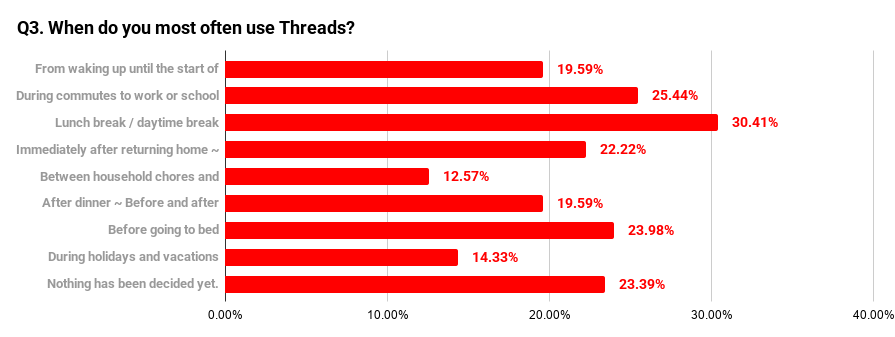
We examine how Threads is integrated into the daily routines of Japanese people by looking at specific usage scenarios. As a medium that allows users to instantly check “what is happening now,” the data reveals that the app is being opened across all aspects of daily life.
Established as a Daytime Refreshment
A detailed look at the 342 responses from our in-house survey reveals that Threads is not fixed to a specific time slot but is instead used during various “transitions” in daily life. The most common response was “during lunch or daytime breaks” at 30.41% (104 people), showing that the habit of updating information between work or studies has taken root.
This was followed by “while commuting” at 25.44% (87 people) and “before bed” at 23.98% (82 people). These data points indicate that because Threads is a light, text-centric medium, it is highly compatible with moments when users want a quick change of pace or to gather information in a short amount of time.
Furthermore, “immediately after returning home and before dinner” was also relatively high at 22.22% (76 people), reflecting users opening the app to catch up on the “now” as they switch from public to private life. The fact that 23.39% (80 people) answered “no specific time” highlights its nature as an infrastructure not limited to a particular time of day.
Those in Their 40s Focus Usage During Lunch Breaks
Comparing usage timing by age group clearly reflects the lifestyles of each generation. Among the prime working-age generation in their 40s, usage during “lunch or daytime breaks” stood out compared to other generations, as they efficiently catch up on information during their limited free time.
For those on the front lines of business, grasping trends or the activities of acquaintances during short daytime gaps has likely become a habit. In contrast, for those in their 20s, in addition to lunch breaks, the percentage of “before bed” usage was high, showing an established rhythm of thoroughly scrolling through the timeline during private nighttime hours.
Furthermore, among seniors aged 60 and older, the response “no specific time” was more frequent than in other generations, suggesting they open the app freely according to their own pace of life. A clear distinction in information consumption rhythms emerged: while the working generations prioritize “daytime efficiency,” the senior demographic utilizes the app within their “available leisure time.”
Women Use It Before Bed, Men Use It While Commuting
Analyzing the differences in usage timing by gender revealed clear distinctions in the motives and moments Japanese men and women engage with Threads. For Japanese women, “before bed” was the top response at 29.03% (45 people), indicating a mainstream style of checking information while relaxing at the end of the day.
This suggests that Threads functions as an “informational window” for women to secure personal time after completing busy housework or daily routines. On the other hand, for Japanese men, usage during “commutes” and “lunch breaks” surpassed that of women.
hotice is a cross-border influencer marketing agency helping overseas brands enter Japan. We handle casting, negotiation, Japanese-language contracts, and ad-disclosure compliance.
Tell us your category, budget range, and timing. We will take it from there.The style of actively opening the app to fill idle time during travel or to maintain social connections while on the go appears to be a male-specific trend. The difference in lifestyle awareness—women utilizing it as “nighttime me-time” and men using it to fill “daytime gaps”—is vividly reflected in these contact timings.
What Are the Main Purposes for Using Threads?
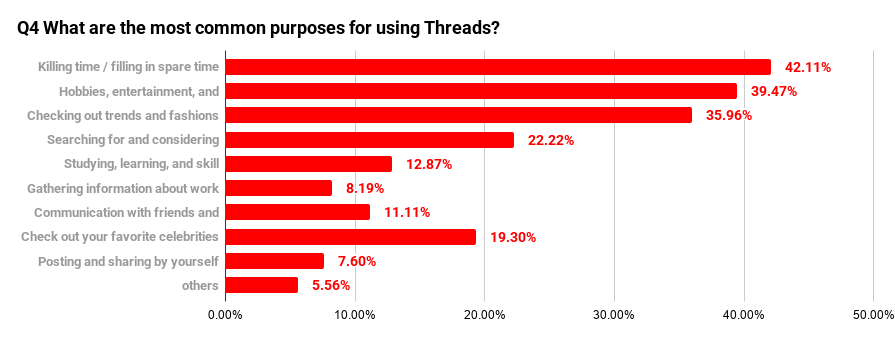
We organize the specific motivations for why Japanese people open Threads based on our compiled survey data. Let’s explore how entertainment and utility intertwine on this platform where new text-based connections are born.
“Killing Time” is the Top Reason at Over 40%
An analysis of the motivations for opening Threads reveals a multi-layered set of needs that go beyond simply “passing the time.” While the most common response was “killing time / filling gap time” at 42.11% (144 people), it is noteworthy that “hobbies, entertainment, and relaxation” also recorded a high figure of 39.47% (135 people).
Furthermore, “checking trends and fads” stood out at 35.96% (123 people), highlighting a clear stance of accessing the app in search of “fresh” information. Additionally, 22.22% (76 people) utilize the platform for “searching for or considering products and services,” showing that using real voices on SNS as a basis for purchasing decisions has become well-established.
On the other hand, “communication with friends and acquaintances” remained at only 14.33% (49 people), suggesting that Threads is shifting its role from a “place to connect” to a “place to obtain information.” The data highlights that modern Japanese people are using Threads in diverse ways as a “personal information base” to deepen their own interests.
Those in Their 40s Focus on Practical Searching
Comparing usage purposes by age group shows how the expected role of Threads shifts according to life stages. For those in their 20s, the percentage of “checking trends and fads” reached 40.28% (29 people), reflecting a high level of sensitivity and a desire to always be in touch with new information.
Additionally, “checking favorite celebrities or influencers” was high among the younger demographic, emphasizing its aspect as a “fan media” for following admired figures. In contrast, among those in their 40s, 27.16% (22 people) use the platform for “searching for or considering products and services,” indicating a stance that prioritizes practicality.
As social responsibilities increase, there is a clear and steady trend toward using real word-of-mouth and specialized insights on Threads as decision-making material to improve quality of life. This survey reveals a distinct shift in purpose across generations: while the younger demographic seeks “emotional stimulation,” the mid-career demographic and above prioritize the “utilization of information.”
Women Expand Their World of Hobbies
A detailed analysis of the differences in purpose by gender highlights contrasting expectations for Threads as a medium. For Japanese women, “hobbies, entertainment, and relaxation” was high at 44.08% (67 people), and their emotional usage—including “checking celebrities”—surpassed that of men.
Threads is favored by women as a tool to expand their favorite worlds and add enrichment to their daily lives. In contrast, for Japanese men, “checking trends and fads” stood at 37.89% (72 people), indicating a priority on quickly grasping global movements.
Furthermore, the percentage of men using the app for “gathering information for work or business” exceeded that of women, suggesting a rational and functional usage style unique to men. The results vividly reflect an essential difference in utilization based on gender: women prioritize “connections with favorites,” while men prioritize “information coverage and effectiveness.”
What Kind of Accounts are Mostly Followed on Threads?
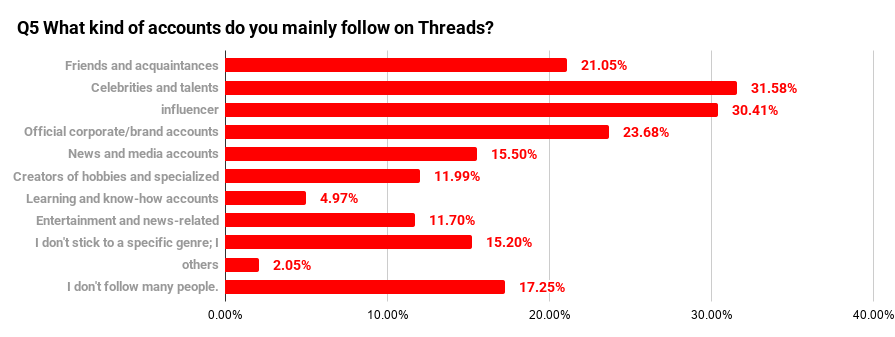
To conclude the survey, we organize which types of accounts are followed and serve as continuous information sources on Threads. In a platform where unique recommendation algorithms are powerful, let’s look at user interests as revealed by their choice of “who to follow.”
Celebrity Follows Exceed 30%
An analysis of which accounts users follow for continuous information consumption reveals a clear style of information gathering centered on “individual character.” The most common response was “Celebrities/Personalities” at 31.58% (108 people), followed by “Influencers” at 30.41% (104 people).
While users follow the movements of official public figures, the unique influence of SNS-native creators holds a significant presence in their timelines. Additionally, 23.68% (81 people) follow “Official Corporate/Brand Accounts,” meaning approximately one in four users receives information directly from companies.
The data highlights that following behavior on Threads has moved beyond mere connections with acquaintances and is increasingly functioning as “personal media construction” to expand one’s own interests. The “personal credibility” of the sender appears to be a crucial factor guaranteeing the value of the information.
Younger Demographic Supports Influencers
Analyzing following trends by age group reveals that the “source of trust” for obtaining information differs by generation. Among the younger demographic in their 20s, the follow rate for “Influencers” reached 41.67% (30 people), indicating that they view stars born from SNS as the most relatable and influential figures.
For them, the words of influencers—delivered with real-time passion—have likely become the most valuable information source. On the other hand, for those in their 40s and older, the tendency to prioritize “Celebrities/Personalities” strengthens, showing a steady preference for following individuals familiar through television and traditional media.
Furthermore, the response “I don’t follow many accounts” tends to increase with age, suggesting that the senior demographic maintains a more passive stance, enjoying the information that flows to them rather than sticking to specific channels. A clear distinction emerged: the younger generation is drawn to “individual passion,” while middle-aged and older generations prioritize “the security of the familiar.”
Women Seek Empathy with Individuals, Men Seek Official Information
A comparison of follow targets by gender reveals different values in the criteria for choosing accounts between Japanese men and women. For Japanese women, the percentage of those following “Celebrities/Personalities” was high at 38.82% (59 people), emphasizing connections based on empathy or admiration for specific individuals.
This suggests that women utilize the following function as a means to enrich their daily lives by incorporating the lifestyles of those they admire and engaging with their worldviews. In contrast, for Japanese men, the percentage of those following “Official Corporate/Brand Accounts” and “News/Media Outlets” surpassed that of women.
Pricing, past campaigns, and how contracts and ad-disclosure compliance are handled from start to finish. Ask us anything before you commit to a budget.
Overseas brands welcome. We work in English, Japanese, Chinese, and Korean.Rather than becoming deeply immersed in a specific individual, a style that prioritizes objectivity—aiming to comprehensively acquire news on social movements and the latest product information—appears to be a male-specific trend. The data vividly reflects an essential difference in SNS utilization: women find motivation in “resonance with people,” while men find it in “information coverage and utility.”
Conclusion
Through this in-house survey, it has become evident that as of 2026, Threads has become a “highly efficient information infrastructure” deeply rooted in the daily lives of Japanese people. The reality—where approximately 20% of respondents access the app daily and about 70% keep their usage within 30 minutes—is symbolic of modern consumer behavior that prioritizes “time performance” (efficiency).
Notably, the fragmentation of needs by age and gender is prominent. A defining characteristic is the coexistence of “deep exploration” by the younger demographic in their 20s and “practical information gathering” by the group centered around those in their 40s. Unique and optimized usage styles have been established for each user: women prioritize empathy with individuals and the expansion of hobbies, while men emphasize comprehensive trend coverage and the collection of official information.
At hotice, we continue to capture these subdivided shifts in user consciousness through data. There is no doubt that Threads—where emotion-stirring text and individual passion intersect—will continue to expand its influence as a new starting point for consumption among the Japanese people.