Latest 2026 Survey: YouTube Purchasing Behavior of 636 Japanese Consumers
- 1. How Often Does YouTube Drive Purchases?
- 1-1. Nearly Half of Japanese Consumers Buy Monthly
- 1-2. One in Five Japanese Consumers in Their 20s Make Purchases Twice a Month
- 1-3. Men Buy Intuitively: Over 12% Make Weekly Purchases
- 2. The Buyer Journey: From YouTube Discovery to Purchase in Japan
- 2-1. Over Half of Japanese Consumers Turn to Search Engines for Verification
- 2-2. Younger Demographics Balance Social Media Reviews and Saved Posts
- 2-3. 35 Percent of Women Inspect Products In-Store Before Purchasing
- 3. What Japanese Consumers Buy After Watching YouTube
- 3-1. 34.66% of Japanese Consumers Buy Food and Beverages Inspired by YouTube
- 3-2. 40% of Japanese Consumers in Their 20s Buy Cosmetics and Clothing
- 3-3. Men Prioritize Hobbies and Utility While Women Focus on Lifestyle Enrichment
- 4. What Drives Japanese Consumers to Buy on TikTok?
- 4-1. 41.83% of Japanese Consumers Value Honest Disclosure of Product Flaws
- 4-2. Teens and Those in Their 50s Value Authenticity, While 20-Somethings Chase Trends
- 5. Average Purchase Value Driven by YouTube in Japan
- 5-1. Men Prioritize Functionality, While Women Tune Into Trends
- 5-2. Daily Spending Between 1,000 and 5,000 Yen Accounts for Nearly 70% of Purchases
- 5-3. Low-Stakes Spending by Teens vs. High-Value Investments by Those Over 50
- 5-4. Concentrated Spending: 42% of Women Purchase in the 1,000 to 3,000 Yen Range
- 6. YouTube: A Critical Infrastructure for Informed Purchasing in Japan
YouTube has evolved far beyond a simple entertainment space. Today, it stands as a massive decision-making engine that actively drives consumer spending across Japan.
The extensive detail provided in video content now serves as the ultimate safety net for Japanese shoppers, directly addressing their strong underlying desire to avoid buyer remorse.
To uncover exactly how watching videos translates into actual sales, we conducted an independent survey of 636 Japanese YouTube users.
Moving beyond basic viewing habits, this latest data unpacks the authentic purchasing journey of Japanese consumers. We explore everything from shopping frequency and the exact type of information that seals the deal, to the average amount spent per transaction.
How Often Does YouTube Drive Purchases?
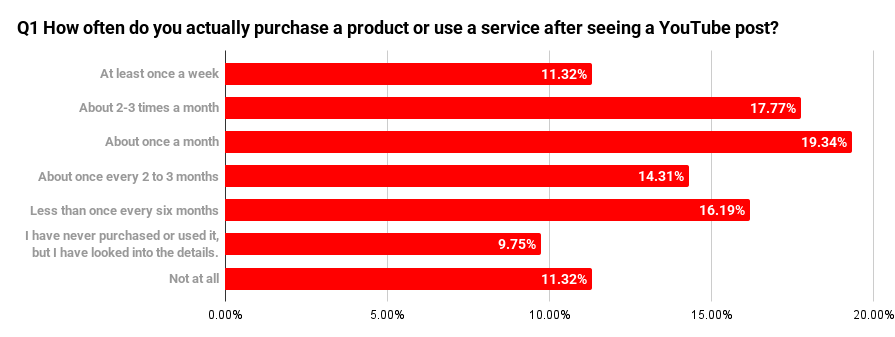
We examined how frequently YouTube content directly impacts viewer purchasing behavior. The results reveal just how deeply the transition from passively watching videos to actively buying products or booking services has become embedded in modern consumer habits.
Nearly Half of Japanese Consumers Buy Monthly
Our recent survey of 636 respondents clearly illustrates that YouTube content now acts as a primary trigger for consumer spending in Japan.
The most common response regarding frequency was making a purchase or booking a service about once a month, accounting for 19.34 percent (123 people). This was closely followed by 17.77 percent (113 people) who buy items two to three times a month.
Furthermore, a highly active segment of 11.32 percent (72 people) completes transactions once a week or more. Combining these groups reveals a striking reality: roughly half of all Japanese consumers take commercial action driven by YouTube videos at least once every month.
Regarding less frequent shopping cycles, 14.31 percent (91 people) make purchases every two to three months, while 16.19 percent (103 people) do so once every six months or less.
Additionally, an interested segment of 9.75 percent (62 people) has actively researched product details after watching a video, even if they have not yet made a final purchase. Ultimately, only a small minority of 11.32 percent (72 people) stated that YouTube has absolutely no influence on their shopping habits.
One in Five Japanese Consumers in Their 20s Make Purchases Twice a Month
A generational breakdown of YouTube-driven purchases highlights a highly active consumer appetite among younger Japanese demographics.
Among teenagers, 22.58 percent (14 people) have made buying once a month a regular habit. The survey also reveals that 21.43 percent (24 people) of consumers in their twenties shop at a high frequency of two to three times a month.
Furthermore, 16.07 percent (18 people) of respondents in their twenties report shopping once a week or more after watching YouTube. For this demographic, the video platform functions much like a digital catalog for discovering and buying the latest trends and products.
Conversely, while the number of non-purchasers increases among Japanese consumers in their forties and older, 11.30 percent (13 people) in their forties noted they have actively researched product details. This indicates that as users age, they carefully evaluate information reliability and highly value YouTube as a powerful research tool for comparing their options.
Men Buy Intuitively: Over 12% Make Weekly Purchases
There are clear gender differences in the journey from watching a YouTube video to completing a transaction.
When it comes to the rapid purchasing behavior of buying once a week or more, men lead at 12.42 percent (40 people), outpacing women at 10.19 percent. Japanese male users show a strong tendency to make snap decisions based on video content, seamlessly transitioning straight to checkout.
In contrast, the survey data highlights the more pragmatic nature of Japanese female users. The behavior of actively researching product details without actually making a purchase was significantly higher among women at 12.10 percent (38 people), compared to men at 7.45 percent (24 people).
Rather than buying immediately upon seeing an influencer recommendation, women tend to verify the information themselves. They prefer to conduct thorough research and only make a purchase once fully convinced, demonstrating a firmly established, process-oriented shopping style.
The Buyer Journey: From YouTube Discovery to Purchase in Japan
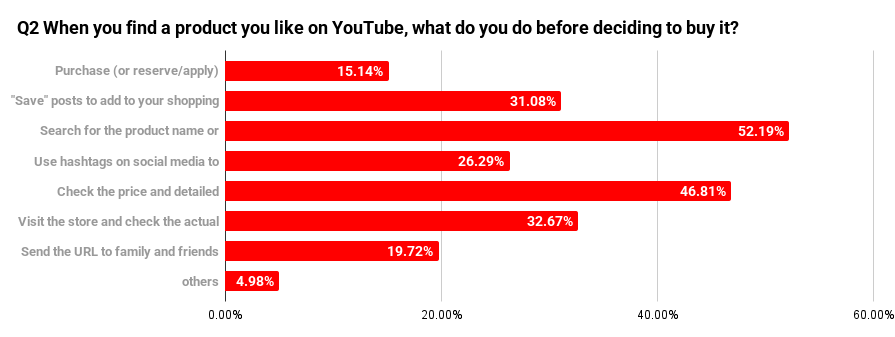
We conducted an in-depth analysis of the specific evaluation process among respondents who reported making at least one purchase triggered by YouTube.
This section explores the authentic behavioral patterns and exact steps Japanese shoppers take between watching a video and actually completing a transaction.
Pricing, past campaigns, and how contracts and ad-disclosure compliance are handled from start to finish. Ask us anything before you commit to a budget.
Overseas brands welcome. We work in English, Japanese, Chinese, and Korean.Over Half of Japanese Consumers Turn to Search Engines for Verification
Responses from 502 Japanese consumers who have made purchases triggered by YouTube reveal a highly cautious decision-making process that relies on a mix of different methods.
The most prominent behavior, reported by 52.19 percent (262 people), involves turning to search engines to look up the specific product or brand name again. This is closely followed by 46.81 percent (235 people) who visit official websites or e-commerce platforms to double-check prices and detailed specifications.
Beyond digital research, a strong contingent of 32.67 percent (164 people) still prefers visiting physical retail stores to examine the actual product in person before committing to a purchase.
Other notable actions include saving posts to build wishlists, done by 31.08 percent (156 people), and searching social media for authentic reviews from everyday users, making up 26.29 percent (132 people).
Additionally, 19.72 percent (99 people) take the extra step of sending URLs to family and friends for consultation and sharing. In stark contrast, only 15.14 percent (76 people) fall into the category of making immediate, on-the-spot purchases. Finally, a small segment of 4.98 percent (25 people) indicated they take other distinct actions.
Younger Demographics Balance Social Media Reviews and Saved Posts
Analyzing the purchasing process by age group highlights a prominent trend among younger Japanese demographics: cross-platform social media research.
Specifically, 35.71 percent (15 people) of teenagers and 31.11 percent (28 people) of those in their twenties reported searching for everyday user reviews via social media hashtags after a YouTube video piqued their interest.
This demonstrates a high level of caution and research savvy unique to younger generations. While they use influencer recommendations as an entry point, they ultimately want to pair that with the authentic, relatable feedback of everyday consumers.
Furthermore, 36.67 percent (33 people) of respondents in their twenties actively save posts to create lists, effectively using YouTube as a personalized digital catalog. The culture of stockpiling content, transforming fleeting information into concrete prospective shopping lists, is deeply ingrained in the purchasing flow of this age group.
Conversely, nearly 60 percent of Japanese consumers in their forties and older rely on search engines for verification. This reveals a clear generational divide in how information is handled, with older demographics prioritizing official sources and accurate specifications over social media trends.
35 Percent of Women Inspect Products In-Store Before Purchasing
A comparative gender analysis reveals distinct differences in how Japanese men and women prioritize their steps leading up to a purchase decision.
For men, over half—50.62 percent (123 people)—reported checking official websites or e-commerce platforms for prices and detailed specifications. This highlights a strong tendency to approach buying logically, carefully analyzing performance and overall cost-effectiveness.
In contrast, a notable 35.91 percent (93 people) of Japanese women prefer to visit physical retail stores to examine the actual product in person before buying. This figure noticeably surpasses the 29.22 percent (71 people) of men who share this behavior.
Additionally, a higher proportion of women, at 22.01 percent (57 people), choose to consult and share product information with family and friends. The survey results clearly indicate that female consumers highly value the opinions of their social circles and the tactile experience of a product, prioritizing a strong sense of personal conviction and satisfaction before finalizing a purchase.
What Japanese Consumers Buy After Watching YouTube
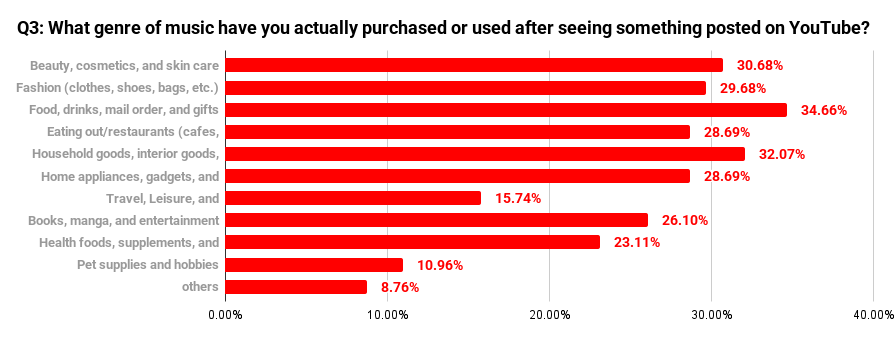
What specific product categories see the biggest boost in consumer spending driven by YouTube content?
Focusing on respondents who reported making at least one purchase, we investigated the actual performance of genres that pair exceptionally well with the dynamic, visual nature of video media.
34.66% of Japanese Consumers Buy Food and Beverages Inspired by YouTube
In a recent survey of 502 Japanese consumers who have made purchases prompted by YouTube videos, we examined the specific product categories they actually bought or used. Taking the top spot was the food, beverages, mail-order treats, and gifts category, accounting for 34.66% (174 respondents).
Following closely behind are categories that enhance everyday living. Household goods, interior decor, and kitchenware claimed 32.07% (161 respondents), while beauty, cosmetics, and skincare products secured 30.68% (154 respondents), showing that lifestyle-enriching items dominate the top ranks.
Fashion, including clothing, shoes, and bags, also maintained a strong presence at 29.68% (149 respondents).
In other areas, dining out and restaurant visits tied with home appliances, gadgets, and smartphone accessories at 28.69% (144 respondents). This indicates a clear consumer preference for highly visual items and experiences when purchasing based on video content.
Furthermore, books, manga, and entertainment content accounted for 26.19% (131 respondents). Health foods, dietary supplements, and fitness gear came in at 23.11% (116 respondents), followed by travel, leisure activities, and accommodations at 15.74% (79 respondents).
Rounding out the survey results, pet supplies and hobby-related items made up 10.96% (55 respondents), with miscellaneous other categories at 8.76% (44 respondents).
40% of Japanese Consumers in Their 20s Buy Cosmetics and Clothing
A closer look at purchasing categories by age group reveals exactly how Japanese consumers utilize YouTube at different stages of their lives.
This trend is particularly evident among those in their 20s, where beauty, cosmetics, and skincare products reached 40.00% (36 respondents), and fashion hit 38.89% (35 respondents). For a generation highly conscious of their social media presence, YouTube serves as an indispensable visual catalog. By allowing them to virtually experience how a product feels or fits through video, the platform helps them confidently avoid buyer remorse.
Meanwhile, among Japanese consumers in their 30s, the food, beverages, mail-order treats, and gifts category peaked at 41.33% (31 respondents), the highest rate across all age brackets. The survey highlights that for this demographic, who are often juggling busy careers and childcare, YouTube videos featuring quick meal ideas or indulgent luxury treats offer an efficient and reliable way to boost their daily quality of life.
Additionally, 34.29% of teenagers (12 respondents) favored books, manga, and entertainment content. For a younger audience that dedicates much of their free time to diving deep into their hobbies, YouTube clearly acts as the primary gateway for discovering new favorite characters, creators, and media franchises.
In contrast, consumers in their 40s and 50s showed a consistent interest in home appliances and gadgets, underscoring the highly practical and grounded purchasing habits of older generations who prioritize utility.
Men Prioritize Hobbies and Utility While Women Focus on Lifestyle Enrichment
When examining purchasing categories by gender, home appliances, gadgets, and smartphone accessories took the top spot among Japanese men at 37.86% (92 respondents). This highlights a strong tendency among male consumers to carefully weigh technical specifications based on video reviews before making a purchase.
Dining out and restaurant visits also ranked high for men at 30.86% (75 respondents), suggesting a clear preference for practical information and tangible experiences.
In sharp contrast, beauty, cosmetics, and skincare products gained overwhelming popularity among Japanese women, reaching 41.31% (107 respondents). Household goods, interior decor, and kitchenware also saw remarkably high engagement at 40.15% (104 respondents).
Furthermore, 39.38% of female respondents (102 people) purchased food and beverages. These survey results clearly indicate that for Japanese women, YouTube acts as a vital platform for discovering new items that elevate and enrich their everyday lives.
hotice is a cross-border influencer marketing agency helping overseas brands enter Japan. We handle casting, negotiation, Japanese-language contracts, and ad-disclosure compliance.
Tell us your category, budget range, and timing. We will take it from there.What Drives Japanese Consumers to Buy on TikTok?
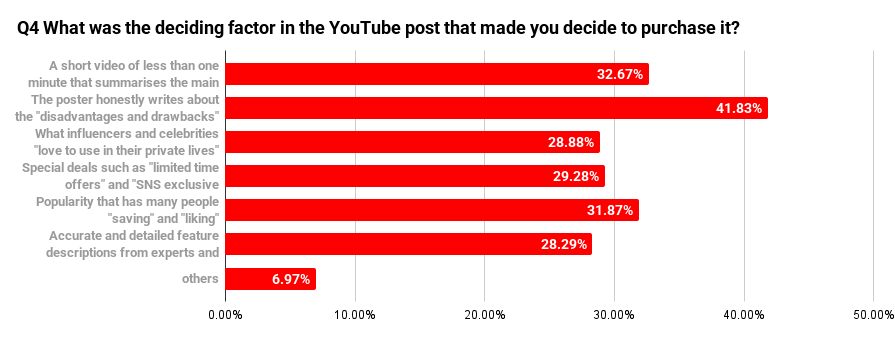
What specific aspects of a video earn viewer trust, and what provides the final nudge needed to complete a transaction? We investigated the core elements and ultimate triggers that lead Japanese consumers to finalize their purchasing decisions.
41.83% of Japanese Consumers Value Honest Disclosure of Product Flaws
An analysis of responses from 502 Japanese shoppers who have made purchases reveals that creator authenticity and concise information are the ultimate keys to conversion.
The most frequently cited deciding factor, reaching 41.83% (210 respondents), was creators openly sharing the drawbacks and flaws they experienced. For Japanese consumers, discussing the negatives alongside the positives is essential for building deep, lasting trust.
Coming in second at 32.67% (164 respondents) were short videos under one minute that effectively summarize the core appeal of a product. This highlights the strong appeal of highly condensed content for demographics that prioritize time efficiency.
Additionally, 31.87% (160 respondents) pointed to social proof and buzz, specifically relying on high numbers of saves and likes as their final reason to buy.
Other significant factors driving purchases include:
・Exclusive Deals: Special offers, such as limited-time sales or social-media-only coupons, captured 29.28% (147 respondents).
・Genuine Endorsements: Seeing influencers and celebrities naturally using the products in their private lives was noted by 28.88% (145 respondents).
・Expert Authority: Accurate and detailed technical explanations provided by industry experts or official brand accounts garnered 28.29% (142 respondents).
Finally, miscellaneous reasons accounted for the remaining 6.97% (35 respondents) of the survey results.
Teens and Those in Their 50s Value Authenticity, While 20-Somethings Chase Trends
There is a distinct generational divide in the type of information Japanese audiences expect from YouTube.
For Japanese teenagers, 49.12% prioritize content where creators are completely transparent about the flaws or downsides of a product. Because this demographic can easily spot overly promotional sponsored content, they strongly demand authentic, unvarnished information. Interestingly, this preference for raw honesty is mirrored by Japanese consumers aged 50 and above. Within this older demographic, a striking 52.00% cite the upfront disclosure of a product’s disadvantages as a crucial deciding factor when making a purchase.
In stark contrast, Japanese users in their 20s are primarily driven by social proof. Among this age group, 38.10%—the highest percentage across all demographics—place the most value on highly saved or liked content. The survey data reveals a purchasing psychology where these young adults actively scan for emerging trends, using online momentum and peer validation as their primary indicators of trust.
Meanwhile, Japanese audiences in their 30s prioritize speed and clarity. A significant 37.89% of this group prefer short videos under one minute that quickly highlight a product’s key selling points. This underscores a practical reality: for busy mid-career professionals juggling work and personal lives, the ability to gather information efficiently serves as a major catalyst for purchasing.
Average Purchase Value Driven by YouTube in Japan
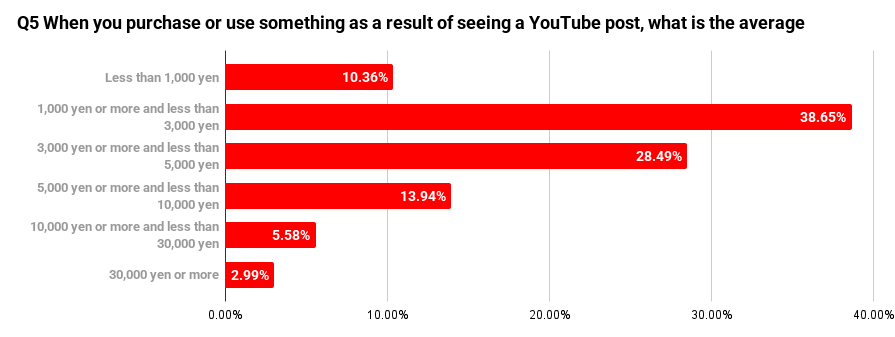
As purchasing through YouTube becomes standard practice, analyzing the average spend per transaction provides a clear measure of the platform’s true economic impact. We examined the actual average price ranges of completed transactions, spanning everything from everyday small purchases to high-ticket investments.
Men Prioritize Functionality, While Women Tune Into Trends
Analyzing the decision-making criteria by gender reveals distinct differences in what Japanese viewers consider trustworthy signals in video content.
Japanese men show a stronger preference for accurate, detailed feature breakdowns provided by experts or official brands, with 30.51% valuing this compared to 25.12% of women. This demographic tends to seek the reassurance of logical, data-backed evidence before making a decision. Additionally, 34.92% of men favor concise videos under one minute that effectively summarize a product’s core appeal, highlighting a strong preference for high information density.
Conversely, Japanese women place greater importance on social buzz, with 32.37% identifying high save and like counts as a key factor—a noticeably higher rate than their male counterparts. This indicates a well-established shopping habit where women actively gauge community feedback and emerging trends to guide their purchasing choices.
Despite these differing approaches, the highest-ranking factor for both demographics is unfiltered transparency regarding a product’s flaws. A significant 43.39% of men and 39.61% of women prioritize content where creators openly discuss the downsides. The survey results ultimately demonstrate that, regardless of gender, Japanese consumers are looking past heavy production value; instead, they demand genuine, honest opinions from YouTube creators.
Daily Spending Between 1,000 and 5,000 Yen Accounts for Nearly 70% of Purchases
Analyzing the responses from 502 active consumers reveals that YouTube functions less as a gateway to luxury and more as a practical guide for enhancing daily life.
The most common expenditure range was 1,000 to 3,000 yen, accounting for 38.65% (194 respondents). This was followed closely by the 3,000 to 5,000 yen bracket at 28.49% (143 respondents), meaning roughly two-thirds of all purchases fall under the 5,000 yen mark.
In other segments, low-stakes purchases under 1,000 yen represented 10.36% (52 respondents), while mid-range spending between 5,000 and 10,000 yen stood at 13.94% (70 respondents).
The platform’s influence on high-ticket items is also noteworthy. A combined segment of Japanese consumers reached higher price points, with 5.58% (28 respondents) spending between 10,000 and 30,000 yen, and 2.99% (15 respondents) committing to major purchases exceeding 30,000 yen. From small everyday essentials to significant investments, it is clear that YouTube is broadening the scope of consumer spending in Japan.
Low-Stakes Spending by Teens vs. High-Value Investments by Those Over 50
The survey reveals a sharp divide in how different age groups use YouTube as a decision-making tool, largely dictated by their disposable income and purchasing goals.
For Japanese teenagers, whose budgets are typically more constrained, spending is concentrated at the lower end of the spectrum. Nearly 70% of this group limits their purchases to under 3,000 yen, with 49.12% spending between 1,000 and 3,000 yen and 19.30% staying under the 1,000-yen mark.
In contrast, consumers in their 50s—who generally enjoy greater financial stability—show a much higher propensity for significant spending. In this demographic, 22.00% reported purchases between 5,000 and 10,000 yen. Furthermore, 8.00% made high-ticket purchases exceeding 30,000 yen, the highest percentage among all age groups. This highlights a cautious and deliberate psychological profile: older generations rely on trusted creators to validate expensive investments, such as high-end appliances or specialty goods, to ensure they do not experience buyer’s remorse.
Interestingly, Japanese adults in their 20s are also beginning to show a willingness to invest. Over 10% of this group reported spending 10,000 yen or more. This suggests that younger consumers are increasingly comfortable relying on video content to justify spending on items they perceive as high-value, establishing a trend of investing generously in things they truly care about.
Concentrated Spending: 42% of Women Purchase in the 1,000 to 3,000 Yen Range
A comparison of spending by gender reveals that the types of products Japanese users discover through YouTube are clearly reflected in their transaction amounts.
Pricing, past campaigns, and how contracts and ad-disclosure compliance are handled from start to finish. Ask us anything before you commit to a budget.
Overseas brands welcome. We work in English, Japanese, Chinese, and Korean.For Japanese men, 16.27% of purchases fall within the 5,000 to 10,000 yen range, with over 10% of total respondents exceeding the 10,000-yen mark. This higher price point is likely driven by a focus on functional categories, such as tech gadgets and hobby-related equipment, where detailed specifications justify a larger investment.
In contrast, spending among Japanese women is heavily concentrated in the 1,000 to 3,000 yen bracket, which accounts for a significant 42.51% of their responses. An additional 12.08% of women make purchases under 1,000 yen. These figures highlight how women utilize YouTube as a primary research tool for recurring daily essentials, such as cosmetics and household goods. The data paints a picture of a pragmatic consumer: by using video content to find products that truly suit their needs, Japanese women are effectively managing their spending while enhancing their overall quality of life.
YouTube: A Critical Infrastructure for Informed Purchasing in Japan
This survey reveals that YouTube has evolved into a powerful digital catalog, with approximately half of Japanese users now making purchases through the platform at least once a month. Japanese consumers use video content as a starting point, followed by careful comparison and research across search engines and social media. Notably, the honest disclosure of a product’s downsides by creators has become the ultimate benchmark for trust.
At hotice, we leverage these latest consumer trends to provide YouTube marketing strategies that resonate deeply with your target audience. If your business is looking to overcome challenges in customer acquisition or conversion through video, please feel free to reach out to hotice for expert support.