Latest 2026 Survey: TikTok Purchasing Behavior of 636 Japanese Consumers
- 1. How Often Does TikTok Drive Purchases Among Japanese Consumers?
- 1-1. Over 40% Make a Purchase at Least Once a Month
- 1-2. Over Half of Users in Their 20s Are Frequent Shoppers
- 1-3. Men Act Decisively, Women Prioritize Research
- 2. From Discovery to Checkout: The TikTok Shopping Journey in Japan
- 2-1. Search Engines Remain the Primary Destination After Discovery
- 2-2. Quick Decisions for the 20s, Deep Dives for the 30s and 40s
- 2-3. Efficiency Drives Men, While Validation Guides Women
- 3. The Top Product Categories Driving Purchases in Japan
- 3-1. Daily Essentials and Food Take Center Stage in TikTok Conversions
- 3-2. Youth Prioritize Self-Enhancement, While Older Generations Focus on the Home
- 3-3. Beauty for Women, Tech and Gadgets for Men
- 4. What Seals the Deal for TikTok Shoppers in Japan?
TikTok is no longer just a social media platform; it has evolved into a powerful gateway for shopping. Countless Japanese consumers are discovering new products through videos and integrating them into their daily lives.
But what specific types of videos actually drive these purchasing decisions? How often are users buying, and how much are they spending?
In this article, we share the results of a comprehensive survey conducted among 631 Japanese TikTok users. Using our latest data, we provide an in-depth analysis of their actual consumer behavior—from how often video views lead to purchases, right down to the real-life steps they take before hitting the checkout button.
How Often Does TikTok Drive Purchases Among Japanese Consumers?
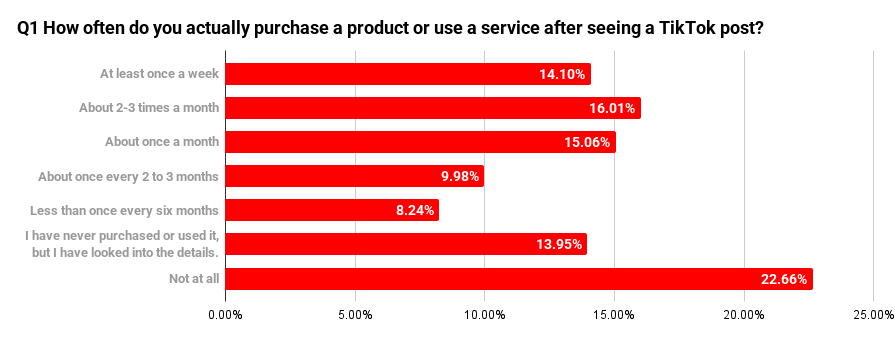
We investigated the frequency with which TikTok content influences Japanese consumer behavior. The findings highlight just how deeply the pipeline—from simply viewing a video to actually purchasing a product or booking a service—has become ingrained in their daily lives.
Over 40% Make a Purchase at Least Once a Month
Looking at the overall survey results, the most common frequency for TikTok-driven purchases is 2 to 3 times a month at 16.01% (101 respondents). This is followed about once a month at 15.06% (95 respondents) and once a week or more at 14.10% (89 respondents).
Combined, over 45% of users are taking some form of purchasing action at least once a month. This highlights a consistent, recurring cycle of consumption sparked by specific content on the platform.
On the less frequent end of the spectrum, 9.98% (63 respondents) shop about once every 2 to 3 months, while 8.24% (52 respondents) do so once every 6 months or less.
Interestingly, even among those who haven’t taken the final step to buy, 13.95% (88 respondents) stated they have never made a purchase but have looked up product details. This clearly demonstrates TikTok’s powerful role as an initial gateway for product discovery.
Over Half of Users in Their 20s Are Frequent Shoppers
When analyzing the data by age group, the exceptional purchasing drive of users in their 20s immediately stands out.
Among Japanese consumers in their 20s, 27.83% (32 respondents) shop once a week or more, and 23.48% (27 respondents) shop 2 to 3 times a month. The survey reveals that over half of the users in this demographic are making TikTok-driven purchases at an extremely high frequency.
This trend is also visible among teenagers, with 17.14% (12 respondents) shopping about once a month. It is clear that younger generations are quick to instantly integrate information discovered on TikTok into their daily lives.
Conversely, the percentage of users with no purchasing experience tends to increase with age. 36.11% (26 respondents) in their 50s and 31.43% (22 respondents) in their 60s stated they never make purchases.
However, it is worth noting that 17.95% (21 respondents) of users in their 40s reported having looked up product details, which is the highest rate across all age groups. This indicates that middle-aged and older demographics are still utilizing TikTok, primarily as a tool for carefully vetting information before making a decision.
Men Act Decisively, Women Prioritize Research
When comparing consumer behavior by gender, the journey from discovery to purchase reveals fascinating differences in how users approach their final decision.
Among Japanese users who take action at least once a week, men slightly lead the way at 15.03% (52 respondents), compared to 12.98% (37 respondents) for women. This suggests that men may have a higher tendency to transition seamlessly from discovering information on TikTok to completing a purchase.
In contrast, when looking at users who have yet to buy or use a product but have taken the time to look up more details, women outpace men at 15.44% (44 respondents) versus 12.72% (44 respondents).
These results highlight a more calculated and thorough approach among female users. After their interest is piqued by TikTok content, they tend to conduct their own extensive due diligence, moving forward only once they are fully satisfied with what they have found.
From Discovery to Checkout: The TikTok Shopping Journey in Japan
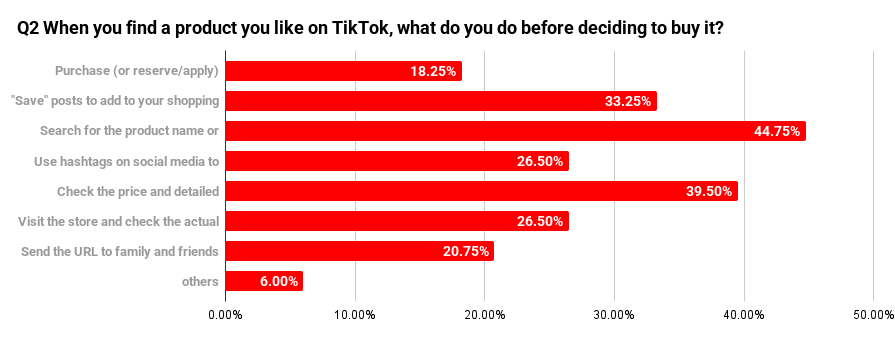
The following sections take a deeper dive into the habits of 400 Japanese users who indicated in Q1 that they have made at least one purchase or used a service through the platform. We have mapped out the specific steps they take from the moment a video catches their eye to the final click on the buy button, providing a detailed look at the decision-making process behind their purchases.
Search Engines Remain the Primary Destination After Discovery
Our research reveals that for Japanese users, a TikTok video is rarely the final stop. The most common reaction after spotting an intriguing product is to perform a follow-up search, with 44.75% (179 respondents) heading to engines like Google to look up specific product or brand names. This behavior is closely followed by 39.50% (158 respondents) who visit official brand sites or major e-commerce hubs like Amazon to scrutinize pricing and technical specifications. Meanwhile, 33.25% (133 respondents) choose to save the post, effectively curating a personal buy-later list for future consideration.
The path to purchase also heavily involves seeking social proof and physical evidence. An equal number of respondents—26.50% (106 people) each—reported searching for authentic user reviews via social media hashtags or visiting a brick-and-mortar store to inspect the item in person. Beyond independent research, social validation plays a role as well, with 20.75% (83 respondents) sharing URLs with family or friends to get a second opinion. Interestingly, the segment of impulse buyers who commit to a purchase or booking on the spot remains relatively small at just 18.25% (73 respondents).
Ultimately, these findings highlight a defining characteristic of the Japanese consumer: a meticulous and cautious shopping style. Rather than relying solely on the information presented within the TikTok ecosystem, they demand external validation and a high level of certainty before they are willing to finalize a transaction.
Quick Decisions for the 20s, Deep Dives for the 30s and 40s
Breaking down the data by age group reveals a stark contrast in how Japanese consumers approach the final purchase. For those in their 20s, the conversion is often instantaneous, with 29.89% (26 respondents) choosing to buy, book, or sign up on the spot—a figure significantly higher than any other generation. This group tends to channel the immediate excitement and momentum sparked by a video directly into a transaction without hesitation.
In contrast, consumers in their 30s and 40s prefer to do their due diligence before committing. External verification is a standard part of their process, as seen in the 54.67% (41 respondents) of those in their 40s and 53.25% (41 respondents) in their 30s who turn to search engines to cross-reference what they have seen. This suggests that while a video captures their interest, it is the secondary research that ultimately seals the deal.
Across the broader spectrum from teens to those in their 40s, the act of saving posts has become a cornerstone of the digital shopping habit. With roughly 30% to 40% of these users actively bookmarking content, it is clear that they are building virtual wishlists as part of their daily routine. Meanwhile, for those in their 50s and beyond, official brand messaging holds the most weight. Over half of the respondents in their 50s—55.56% (20 people)—prioritize visiting official websites to scrutinize technical specifications, relying on verified data as their primary compass for decision-making.
Efficiency Drives Men, While Validation Guides Women
When examining the data through a gendered lens, clear distinctions emerge in how information is prioritized during the decision-making process. Men show a strong inclination toward a logical and high-efficiency approach, with 46.19% (103 respondents) turning to search engines and 41.70% (93 respondents) verifying details on official websites or e-commerce marketplaces. For these users, the primary goal is to rationalize the purchase by scrutinizing technical specifications and price competitiveness.
In contrast, women tend to favor a more deliberative and curated shopping style. A notable 37.29% (66 respondents) prefer to save posts, effectively building a digital inventory of items to consider over a longer period. Furthermore, women place a higher premium on social proof; 29.94% (53 respondents) actively seek out authentic user reviews on social media, outstripping the 23.77% (53 respondents) of men who do the same. This highlights a desire among female consumers to ensure satisfaction through real-world testimonials before committing.
Interestingly, the gender gap closes entirely when it comes to the final moment of conversion. The rate of immediate purchases stands at 18.08% (32 respondents) for women and 18.39% (41 respondents) for men. This parity suggests that, regardless of the research path taken, the phenomenon of making an instant purchase through TikTok has become a normalized behavior across the board in the Japanese market.
The Top Product Categories Driving Purchases in Japan
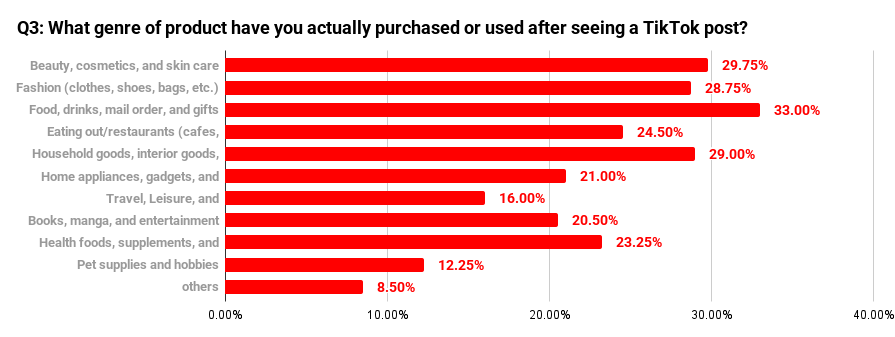
Our research also sought to identify exactly which product categories and services are gaining the most traction through TikTok content. The findings reveal a remarkably broad spectrum of influence on Japanese consumer habits, ranging from everyday lifestyle staples to more specialized sectors like hobbies and entertainment. This data paints a clear picture of how TikTok has evolved into a significant driver of commerce across a diverse array of industries, touching nearly every aspect of the modern Japanese lifestyle.
Daily Essentials and Food Take Center Stage in TikTok Conversions
Our analysis into the specific categories purchased through TikTok reveals that food, beverages, and specialty gourmet gifts are the primary drivers of commerce, leading the pack at 33.00% (132 respondents). This indicates that items seamlessly integrated into daily dietary habits hold the strongest appeal for the Japanese audience. Following closely are beauty and cosmetics at 29.75% (119 respondents) and household goods or interior decor at 29.00% (116 respondents). These figures underscore the continued dominance of categories that thrive on high-impact visual storytelling and aesthetic appeal.
Trend-driven sectors also maintain a significant presence in the TikTok ecosystem. Fashion items, including apparel and accessories, accounted for 28.75% (115 respondents), while the dining-out sector—comprising cafes and restaurants—captured 24.50% (98 respondents). The influence of the platform further extends into lifestyle-enhancement categories, with health and fitness products attracting 23.25% (93 respondents), followed by consumer electronics and gadgets at 21.00% (84 respondents), and entertainment media like books or manga at 20.50% (82 respondents).
The reach of TikTok even touches more specialized or high-consideration areas, such as travel and leisure at 16.00% (64 respondents) and pet supplies or hobbies at 12.25% (49 respondents). Finally, a small segment of 8.50% (34 respondents) reported making purchases in miscellaneous categories not covered by the primary groups. Collectively, these results demonstrate that while TikTok is a powerhouse for discovering the latest trends, its most profound impact on the Japanese market lies in the most relatable and essential aspects of everyday life.
Youth Prioritize Self-Enhancement, While Older Generations Focus on the Home
A deeper look at the data by age group reveals a fascinating divergence in purchasing priorities. For Japanese teenagers, TikTok acts as a primary engine for self-actualization and personal branding. Both the beauty and fashion categories saw an identical and remarkably high engagement rate of 42.86% (21 respondents), signaling that younger users view the platform as an essential manual for refining their personal image. Those in their 20s mirror this enthusiasm for aesthetics but add a social dimension to their consumption, with 31.03% (27 respondents) leveraging the app to discover and visit trendy dining spots and restaurants.
In sharp contrast, the interests of users aged 40 and above pivot toward more pragmatic and utilitarian sectors. Food and beverages emerge as the dominant force for this demographic, capturing 42.67% (32 respondents) of those in their 40s and a nearly identical 42.50% (17 respondents) among users aged 70 and over. This shift toward the functional is even more pronounced among those in their 60s, where household goods and interior decor take the lead at 36.11% (13 respondents).
Ultimately, these patterns suggest a clear developmental shift in how TikTok is utilized. While the younger generation uses the platform to invest in themselves and their social lives, older consumers increasingly turn to it to source sensible, grounded products designed to elevate the comfort and quality of their everyday domestic environments.
Beauty for Women, Tech and Gadgets for Men
The data reveals a clear divergence in purchasing interests when viewed through the lens of gender. For Japanese women, the impact of TikTok is highly concentrated within specific lifestyle niches. Beauty, cosmetics, and skincare stand out as the undisputed leader, with a significant 44.07% (78 respondents) making purchases in this category. This is followed by food and beverages at 32.77% (58 respondents) and fashion at 32.20% (57 respondents), suggesting that for women, the platform serves primarily as a catalog for self-care and personal style.
In contrast, while food and beverages also claim the top spot for men at 33.18% (74 respondents), their spending habits are notably more diversified across hobby-centric categories. A striking difference appears in the tech and media sectors: 26.46% of men (59 respondents) purchased electronics or gadgets, and 24.22% (54 respondents) invested in books, manga, or entertainment content. These figures far outpace the female demographic, where interest in electronics and entertainment sits much lower at 14.12% and 15.82%, respectively.
These results highlight the multifaceted nature of the TikTok-driven sales phenomenon in Japan. The platform does not just trigger impulse buys in a single category; rather, it ignites specific purchasing cycles tailored to gendered preferences. While women are predominantly moved by content related to self-enhancement and culinary discovery, men are increasingly reaching for their wallets to fund technological interests and personal pastimes.
What Seals the Deal for TikTok Shoppers in Japan?
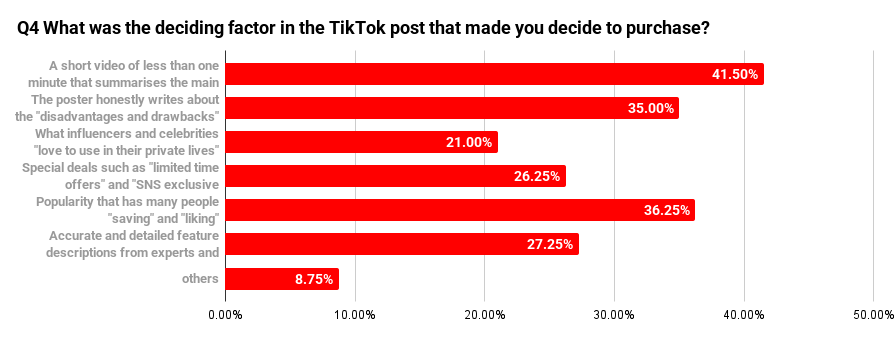
The journey from watching a short video to completing a transaction requires a specific kind of momentum. We set out to identify the final nudge—the precise catalyst that convinces a Japanese consumer to move past the screen and commit to a purchase. Our research explores the specific elements where users find the most value, examining everything from the way information is curated and presented to the fundamental levels of credibility and the unique viral reach inherent to social platforms. By pinpointing these decisive factors, we can better understand what ultimately earns a user’s trust and inspires them to hit the buy button.
Efficiency and Honesty: The Dual Drivers of the Japanese Purchase
The results of our study highlight a clear preference for brevity and clarity in the decision-making process. The leading factor that pushes Japanese users toward a purchase is the ability to grasp a product’s essence quickly; 41.50% (166 respondents) stated that a concise video under one minute, which effectively summarizes the key selling points, is their primary motivator. This underscores how deeply the concept of time performance—or taipa—has integrated into the Japanese psyche, where the efficiency of information gathering is a direct catalyst for consumer intent.
Beyond speed, social validation and radical transparency are crucial in building the necessary trust to finalize a sale. The popularity of a post, measured by high save and like counts, influences 36.25% (145 respondents), proving that a sense of collective approval is a powerful nudge. Furthermore, 35.00% (140 respondents) place a high premium on honesty, specifically looking for creators who are willing to disclose drawbacks or flaws. This suggests that for many, a perfectly polished advertisement is less convincing than a balanced, authentic review that addresses potential risks.
Technical authority and direct incentives also round out the decision-making framework. Accurate, detailed functional explanations provided by experts or official brand channels are valued by 27.25% (109 respondents), while 26.25% (105 respondents) are swayed by the tangible benefit of discount coupons. Interestingly, the influence of celebrity endorsements follows at 21.00% (84 respondents), trailing behind the demand for peer-driven social proof and official data. Finally, miscellaneous factors accounted for the remaining 8.75% (35 people). Taken together, these insights suggest that to win over the Japanese TikTok audience, brands must master the art of the 60-second summary while maintaining a commitment to transparency and verified facts.
30s Seek Efficiency, While Teens Demand Authenticity
A closer look at the generational data reveals that the final push toward a purchase is triggered by very different psychological drivers depending on the user’s age. For those in their 30s, efficiency is the clear winner; over half of this group (51.95%, or 40 respondents) identified summarized key points as their top motivator. This reflects a lifestyle where time is a premium, and users are looking for content that cuts through the noise to deliver immediate value.
In contrast, the teenage demographic operates on a different frequency, prioritizing both social buzz and raw transparency. For these younger users, the honest mention of a product’s drawbacks and its overall popularity tied as the leading factors at 40.82% (20 respondents) each. This suggests that digital natives have developed a sophisticated filter for traditional advertising; they are far more likely to be swayed by authentic, credible information than by a perfectly polished but one-sided promotional pitch.
Interestingly, the desire for a balanced perspective is not exclusive to the youth. Nearly half of the respondents in their 50s (47.22%, or 17 people) also placed a high value on the inclusion of product negatives. This shared sentiment across the age spectrum highlights a critical shift in the Japanese market: regardless of age, a transparent review that dares to mention what isn’t perfect has become one of the most potent catalysts for driving a consumer to take action.
Social Proof Drives Women, While Technical Expertise Wins Over Men
Our gender-based comparison reveals a distinct split in the type of information that earns a consumer’s trust. For Japanese women, the social weight of a product is a major deciding factor; 38.98% (69 respondents) indicated that high engagement, such as saves and likes, serves as their primary benchmark. This suggests that female shoppers are highly attuned to communal reactions and cultural trends, often using social consensus as a reliable filter for quality before committing to a purchase.
In contrast, men are more likely to prioritize objective evidence and authoritative data. Our findings show that 30.04% (67 respondents) look for precise functional descriptions from experts or official brand sources—a figure that notably outpaces the 23.73% (42 respondents) recorded for women. It is clear that for male consumers, technical validation and a solid factual foundation are the most effective keys to finalizing a decision.
Despite these differing priorities, both genders find common ground in their demand for brevity. The preference for summarized videos under one minute remains consistently high, valued by 41.24% (73 people) of women and 41.70% (93 people) of men. This universal appreciation for condensed content reveals that TikTok’s specific style of delivery—offering a visual and informative shorthand—is the most powerful cross-gender catalyst for driving commerce in the modern Japanese market.
From Micro-Spends to High-Ticket Services: The Price Tag of the TikTok Effect
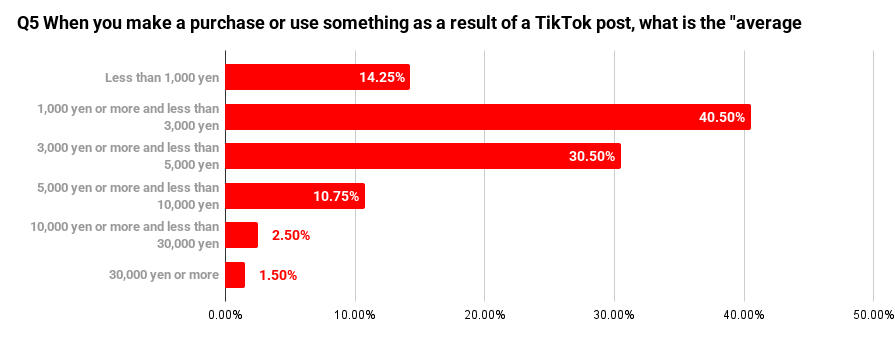
Beyond knowing what they buy, it is crucial to understand the financial commitment behind each TikTok-inspired transaction. Our research explored the average budget Japanese users set aside when a video discovery leads to a purchase, aiming to uncover the true scale of the platform’s influence on the Japanese wallet. We examined the full spectrum of spending, from the casual acquisition of budget-friendly staples to significant investments in high-end services. By mapping these financial thresholds, we gain a clearer picture of the modern Japanese consumer’s spending sensibilities and the monetary value of the momentum generated by TikTok content.
Low-Stakes Shopping: The Sweet Spot Under 3,000 Yen
Our investigation into the average spend per transaction reveals that TikTok-inspired purchases in Japan are predominantly concentrated in the more affordable price brackets. The most common spending tier is between 1,000 and 3,000 yen, accounting for 40.50% (162 respondents). This is followed by the 3,000 to 5,000 yen range at 30.50% (122 respondents) and the sub-1,000 yen category at 14.25% (57 respondents). When combined, these figures show that roughly 85% of all transactions remain below the 5,000 yen mark. This highlights TikTok’s role as a primary driver for casual, low-stakes spending—items that offer a sense of discovery without the fear of a significant financial setback.
However, the platform’s influence is not limited to micro-transactions alone. While smaller in number, a segment of users is moving toward higher price points, with 10.75% (43 respondents) spending between 5,000 and 10,000 yen. Even more substantial investments are occurring, as 2.50% (10 respondents) reported spending between 10,000 and 30,000 yen, and 1.50% (6 respondents) exceeded the 30,000 yen threshold. Although high-ticket items are currently in the minority, these results confirm that a certain portion of the Japanese audience is already comfortable making significant financial commitments through the platform.
Youthful Splurging vs. Mature Pragmatism
When we slice the data by age, a clear divergence in financial appetite comes to light. Those in their 20s emerge as the generation most willing to spend, with 39.08% (34 respondents) typically landing in the 3,000 to 5,000 yen bracket. This group leads the pack in terms of average transaction value, suggesting that younger Japanese consumers view TikTok discoveries as worthy investments. Whether it is for self-improvement or staying ahead of the latest trends, they are prepared to open their wallets a bit wider for items that enhance their lifestyle or personal brand.
In stark contrast, the 40s and older demographics adopt a much more conservative and grounded spending model. A majority of those in their 40s—52.00% or 39 respondents—keep their purchases within the modest 1,000 to 3,000 yen range. This pragmatic pattern remains consistent even among users aged 70 and over, where 52.50% (21 respondents) opted for the same price tier. These results paint a picture of a mature audience that utilizes TikTok as a tool for sensible, low-cost acquisitions. For these users, the platform is less about chasing luxury or status and more about finding practical daily essentials and groceries that offer immediate utility without breaking the bank.
Men Invest in Premium Tiers While Women Cluster Around the 3,000 Yen Range
Our gender-based analysis of average purchase prices reveals that men are more inclined to reach for higher-ticket items when shopping via TikTok. While only 3.39% (6 respondents) of women made purchases exceeding 10,000 yen, the figure for men rose to 4.49% (10 respondents). This trend continues in the mid-to-high range, where 12.56% (28 men) spent between 5,000 and 10,000 yen, compared to just 8.47% (15 women). This shift toward premium spending is likely a direct result of the male preference for electronics and gadgets—categories that naturally command higher price points than typical social media impulse buys.
On the other hand, female spending patterns show a remarkable concentration within affordable and mid-range brackets. Over 70% of women’s purchases are focused within two specific tiers: 40.68% (72 respondents) spending between 1,000 and 3,000 yen, and 32.77% (58 respondents) spending between 3,000 and 5,000 yen. This data paints a picture of a consistent and sensible consumption style among Japanese women. They appear to use TikTok as a curated catalog for discovering high-value, accessible items like beauty products and household accessories—products that offer immediate personal satisfaction without venturing into high-risk financial territory.
TikTok is Redefining the Japanese Consumer Journey
Through this study, it has become clear that TikTok in Japan has evolved far beyond a mere entertainment platform; it is now a trusted launchpad for the entire shopping experience. Perhaps the most striking takeaway is the uniquely Japanese approach to consumption: a hybrid of high-speed efficiency and meticulous scrutiny. While users value the ability to grasp a product’s appeal through short-form video, they rarely skip the step of due diligence, frequently cross-referencing information on external sites to ensure their choice is sound.
At the heart of this behavior is a deep-seated desire to avoid making the wrong purchase. This risk-averse mindset means that Japanese consumers now prioritize radical honesty and objective data over traditional promotional hype. Across every age group and gender, the presence of authentic reviews—including the disclosure of potential drawbacks—has become the ultimate deciding factor in earning a user’s trust and opening their wallet.
In this evolving landscape, a successful business strategy must do more than just broadcast; it must precisely hit these nuanced psychological triggers to maximize the brand experience. Navigating these complexities requires a sophisticated SNS strategy that understands the subtle heartbeat of the Japanese market. At hotice, we specialize in everything from high-impact video production to comprehensive strategic management. If you are looking for a marketing partner who can resonate deeply with the Japanese consumer and provide the expert insights needed to power your brand’s growth, we invite you to reach out to us. We are here to provide the professional support necessary to turn your next challenge into a major success.
.jpg)