2026 Update: The Landscape and Strategy of YouTube Influencer Marketing in Japan
- 1. 2026 Latest Survey: YouTube Usage Report in Japan
- 1-1. Two-Thirds of Japanese People Use It Daily
- 1-2. 70% Watch for Moderate Durations of Less Than 2 Hours
- 1-3. Peak at Relaxation Time Before Bed
- 1-4. Purpose Deepens as a Knowledge Tool
- 1-5. Following Individual Expertise Over Official Brands
- 2. 2026 Latest Survey: YouTube Purchasing Behavior of Japanese Individuals
- 2-1. Approximately Half of Users Reach the Level of Purchasing Once a Month or More
- 2-2. Half of Users Perform Re-research via Search Engines
- 2-3. Centered on “Familiar Food” such as Groceries and Household Goods
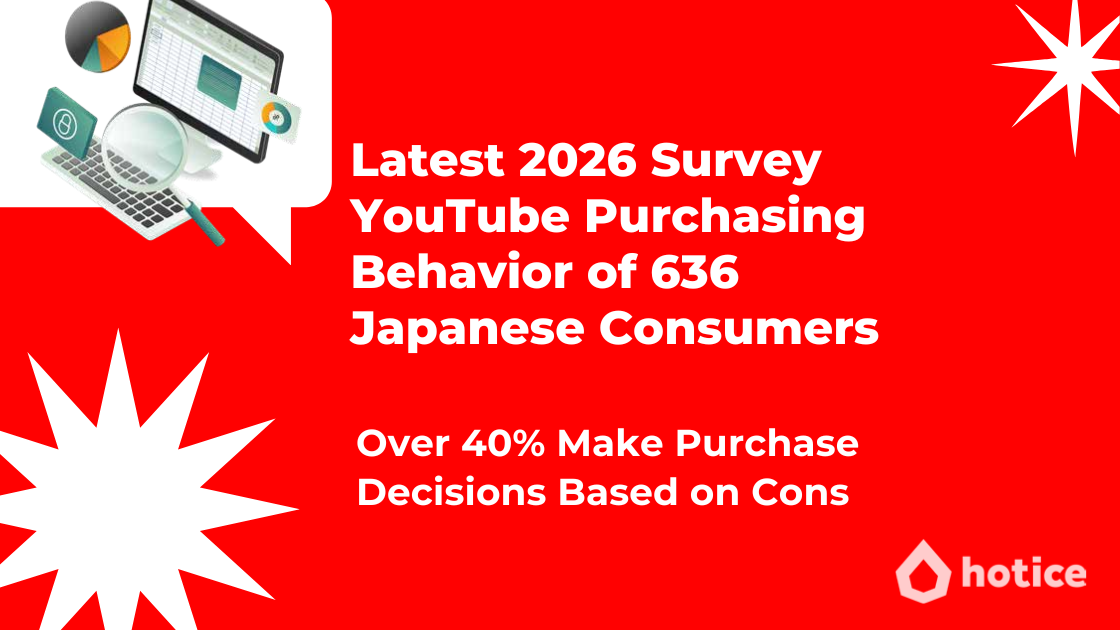
- 2-4. Over 40% Emphasize the “Mention of Disadvantages”
- 2-5. Low Unit Prices Between 1,000 Yen and 5,000 Yen Are Mainstream
- 3. Market Trends of YouTube in Japan in 2026
- 3-1. Overwhelming Reach of 73.7 Million Domestic Active Users
- 3-2. Expansion of Connected TV (CTV) Viewing and Impact on Household Purchasing
- 3-3. “Clipping Videos (UGC)” in Elections and Social Affairs
- 3-4. YouTube’s Position in the Influencer Marketing Market
- 4. YouTube Marketing Strategies to Win in Japan in 2026
In 2026, YouTube in Japan has transcended the boundaries of a mere entertainment venue and has become an essential lifestyle infrastructure used by everyone every day. Today, Japanese people do not just watch videos; they utilize YouTube to solve their problems or to acquire new knowledge.
There, a new form of trust in influencer marketing has emerged—one that is entirely different from what was seen up until 2025. To decode the “now” of YouTube, a platform utilized by 73.7 million people in Japan, hotice conducted an extensive independent study.
How do Japanese people use YouTube, and what do they believe in when they buy products? We will interpret the real facts from the latest data. hotice will provide a clear explanation of the marketing strategies necessary to move people’s hearts through videos and lead them to make informed choices in the Japan of 2026.
2026 Latest Survey: YouTube Usage Report in Japan
hotice conducted a survey regarding the current status of YouTube usage as of 2026, targeting 531 individuals residing within Japan. Based on data, we will explain the actual state of how Japanese people utilize the platform, covering everything from daily usage frequency and specific viewing times to the timing of opening the app, purposes of use, and following trends.
Two-Thirds of Japanese People Use It Daily
When investigating the extent to which YouTube is used on a daily basis in 2026, 348 people, representing 65.54% of users in Japan, responded that they use it almost every day. When combined with the 9.98% who use it four to five days a week and the 10.73% who use it two to three days a week, approximately 86% of the total open YouTube as a daily routine.
By age group, the enthusiasm of those in their 10s is particularly overwhelming, with a high percentage of 80.00% using it every day. The 20s and 30s segments also exceed 70%, confirming that in the Japan of 2026, YouTube has become completely established as a standard infrastructure.
The penetration into the senior segment is noteworthy. Even among those aged 70 and over, more than half, at 53.57%, use it every day, and it can be said that the gap in usage frequency between generations has been almost eliminated by 2025. By gender, while daily usage for men is 69.41%, it is 58.64% for women. The background has been highlighted where the segment of Japanese men who actively engage with YouTube daily without fail is thicker.
70% Watch for Moderate Durations of Less Than 2 Hours
Regarding viewing time on days when YouTube is used, the mainstream style is not just for gap consumption but for sitting down and enjoying it like television. In 2026, the largest volume zone is 30 minutes or more but less than 60 minutes, at 25.05%.
When adding the 23.88% for 1 hour or more but less than 2 hours and the 21.94% for 10 minutes or more but less than 30 minutes, approximately 70% of total users keep their viewing within 2 hours. By generation, the degree of immersion among those in their 10s is extremely high, with more than 40% spending 2 hours or more on YouTube every day.
On the other hand, among those in their 50s and older, there is a stronger tendency to efficiently consume necessary information, making compact viewing of 30 minutes to 1 hour predominant. Differences by sex are also seen; while approximately 57% of women finish within 1 hour, men showed results exceeding women in immersive, long-duration viewing, digging deep into fields of interest.
Peak at Relaxation Time Before Bed
Analyzing the contact points in the daily lifelines of 2026, it is clear that YouTube is incorporated into the Japanese lifestyle as a switch for knowledge and entertainment. Usage is highest before bed at 44.85%, followed by lunch breaks or daytime break periods at 28.35%, and from after dinner to before or after bathing at 27.96%.
Among those in their 10s, usage before bed exceeds 70%, making it an indispensable habit to spend nighttime relaxation time with videos. In contrast, for the prime working generation in their 40s, there is a strengthening tendency to devote daytime break periods to refreshing. Because communication through influencers is delivered at the moments when these users are most relaxed and receptive to information, it enables deep trust building.
Purpose Deepens as a Knowledge Tool
The purpose of use is largest for killing time or filling gap time at 69.32%, but in 2026, practical utilization as a video-based knowledge infrastructure is accelerating. While hobbies and entertainment follow at 63.88%, the segment aiming for study, learning, or skill-up has reached 29.13%, and the segment aiming for searching for or considering products and services has reached 21.94%.
Particularly in the 30s and 40s, the percentage for learning purposes is high, clearly showing an attitude of trying to efficiently acquire know-how useful for work and life through video. While women seek trends and empathy, men are notable for utilitarian utilization, emphasizing knowing and solving. The behavior of confirming actual usage feel and professional explanations through video has become common, and in the Japan of 2026, YouTube has become the greatest tool supporting the decision-making of Japanese people who do not want to fail.
Following Individual Expertise Over Official Brands
Looking at the trends of subscribed channels, the reality is seen that Japanese users place more weight on individual expertise and charm than on organizational titles. While celebrities and talents gathered high support at 46.80% and influencers at 38.25%, the proportion following official corporate or brand accounts remains at 18.83%.
The younger the age group, the thicker the trust in influencers, with approximately 60% of those in their 10s following their activities. On the other hand, as age increases, there is a stronger tendency to strictly select and follow accounts that possess deep knowledge in hobbies or specialized fields. To succeed in marketing in the Japanese market of 2026, it is essential to correctly grasp the location of such user trust and to provide highly specialized communication through the filter of an influencer.
2026 Latest Survey: YouTube Purchasing Behavior of Japanese Individuals
To clarify the reality of how video viewing leads to actual payments, we conducted an independent survey targeting 636 Japanese YouTube users. We will unravel the real purchasing process of Japanese people from the latest data.
Approximately Half of Users Reach the Level of Purchasing Once a Month or More
This survey revealed the reality that YouTube has become a major switch moving the wallets of Japanese people. The segment purchasing about once a month accounted for 19.34% (123 people), followed by about two to three times a month at 17.77% (113 people); when including the 11.32% (72 people) who purchase once a week or more, approximately 50% of the total take purchasing actions at least once a month.
The action power of those in their 20s is particularly overwhelming, with 21.43% (24 people) purchasing two to three times a month, and 16.07% (18 people) shopping via YouTube at least once a week. For the younger generation, YouTube has already established its position as the latest product catalog. In terms of gender, while 12.42% (40 people) of men show a tendency for quick decisions by purchasing once a week or more, many women—12.10% (38 people)—responded that they “researched details before purchasing,” highlighting a posture of careful consideration.
Half of Users Perform Re-research via Search Engines
Analyzing the behavior of 502 people who have experience purchasing triggered by YouTube, we see a cautious stance of performing background checks through multiple means after watching a video. The most common action reached 52.19% (262 people), re-searching on search engines, followed by confirming specs on official websites or EC malls at 46.81% (235 people).
The segment making an immediate decision on the spot remained at only 15.14% (76 people), and a style of buying after gaining a sense of conviction from external data is the mainstream in 2026. 35.71% (15 people) of those in their 10s and 31.11% (28 people) of those in their 20s responded that they look for reviews from ordinary people on SNS after watching YouTube. It is evident that they possess high research capabilities, using influencer introductions as an entry point while simultaneously checking the true feelings of users similar to themselves. Differences by gender are also prominent, with 50.62% (123 people) of men preferring logical analysis on official websites, while 35.91% (93 people) of women confirm the actual product at a store. Women tend to emphasize the opinions of those around them and the actual texture, moving toward payment with a sense of conviction.
Centered on “Familiar Food” such as Groceries and Household Goods
We investigated which specific categories of information dissemination on YouTube are stimulating consumption among Japanese people. The most common was food, beverages, gourmet mail-order, and gifts at 34.66% (174 people). This was followed by household goods, interior decor, and kitchenware at 32.07% (161 people), and beauty, cosmetics, and skincare at 30.68% (154 people).
40.00% (36 people) of those in their 20s purchase beauty/cosmetics and 38.89% (35 people) purchase fashion, utilizing YouTube as a catalog for self-improvement. Meanwhile, for those in their 30s, food and beverages reached 41.33% (31 people), the highest across all age groups, revealing the reality that it is directly linked to improving the QOL of a busy generation. Differences by gender are also clear, with men’s most frequent category being home appliances and gadgets at 37.86% (92 people). In contrast, women actively select items that enrich daily life, with beauty/cosmetics at 41.31% (107 people) and household goods at 40.15% (104 people).
Over 40% Emphasize the “Mention of Disadvantages”
We investigated what viewers place their trust in and what serves as the final deciding factor for payment. The most votes were gathered by the fact that disadvantages and flaws felt by the poster are also honestly written, reaching 41.83% (210 people). The sincerity of sharing not only the good points but also the negative aspects leads to deep trust from Japanese people.
This was followed by the point that key points are summarized in short videos of one minute or less at 32.67% (164 people), which resonates with the segment that values time-performance (Taipa). 49.12% of those in their 10s and 52.00% of those aged 50 and over support the mention of disadvantages, showing a strengthening tendency to avoid excessive production. Men value accurate functional explanations by experts (30.51%) as a logical basis. On the other hand, women tend to sensitively capture trendiness on SNS (32.37%), and regardless of gender, the “sender’s true feelings” are the greatest trigger moving purchases in 2026.
Low Unit Prices Between 1,000 Yen and 5,000 Yen Are Mainstream
When investigating the average expenditure per purchase via YouTube, the economic impact of video became clear. The most common was 1,000 yen or more but less than 3,000 yen at 38.65% (194 people). This was followed by 3,000 yen or more but less than 5,000 yen at 28.49% (143 people), meaning approximately 70% of the total fall within the range of 5,000 yen or less for “daily expenditures.”
Looking at age groups, among those in their 50s whose income is stable, high-amount responses of 30,000 yen or more were 8.00%, the highest among all generations. For expensive investments where one does not want to fail, a psychology works to buy with conviction by referring to videos of trusted influencers. For women, expenditures between 1,000 yen and less than 3,000 yen for cosmetics and daily necessities are concentrated at 42.51%. On the other hand, for men, the segment of 5,000 yen or more exists at nearly 30%, with categories emphasizing functionality, such as gadgets and hobby tools, pushing up the amount.
Market Trends of YouTube in Japan in 2026
The background behind YouTube’s decisive influence on Japanese consumer behavior lies in the gigantism of the platform itself and a paradigm shift in the environment surrounding the digital market. Between 2025 and 2026, YouTube transcended the boundaries of existing entertainment and underwent a dramatic evolution into a “social foundation (life infrastructure)” that governs purchasing decisions and information searching. Here, we unravel the latest market data and its transitions, which are indispensable for constructing next-generation marketing strategies.
Overwhelming Reach of 73.7 Million Domestic Active Users
In the Japan of 2026, YouTube is no longer just a video platform; it has become the largest visual infrastructure covering all generations. According to the latest SNS user data, the number of monthly users in Japan has surpassed 73.7 million. This figure represents the second-largest scale in the country, following LINE, meaning that more than half of Japan’s total population interacts with YouTube on a daily basis.
In an analysis based on surveys by the Ministry of Internal Affairs and Communications, the usage rate exceeds 80% across each segment from the 10s to the 50s. What is particularly noteworthy is that, overturning the former image of being centered on the youth, the 40s and 50s segments with purchasing power now form the largest volume of active users. The breadth of reach also extends to regional characteristics, and its uniform penetration from urban areas to rural regions is another strength of YouTube. This overwhelming population, capable of directly approaching a wide range of attributes, has become the most reliable target for appeal when deploying influencer marketing in Japan.
source : 情報通信分野の現状と課題
Expansion of Connected TV (CTV) Viewing and Impact on Household Purchasing
In the Japan of 2026, the main battlefield for YouTube viewing has jumped out of smartphone screens and expanded to television screens in living rooms. According to the “Connected TV White Paper” jointly announced by Cross Marketing and REVISIO, the average viewing time for YouTube has reached 53.4 minutes per day. This figure ranks second in the overall program rankings, including terrestrial broadcasting, indicating that YouTube possesses a presence in Japanese households equivalent to that of major broadcasting stations.
Of particular note is the establishment of co-viewing (simultaneous viewing by two or more people) through television devices. While YouTube was previously considered a medium specialized for individual tastes, the normalization of viewing on large screens has dramatically increased opportunities to enjoy content with family or partners. This change in viewing style is causing a tectonic shift in the purchasing process of Japanese people. YouTube has come to function as a place for consensus building, not only for consumption completed by an individual but also for products requiring family discussions, such as travel, home appliances, and groceries. Information introduced by influencers on the living room television is no longer a matter of individual interest; it has become a powerful trigger directly affecting the purchasing decision rights of the entire household.
source : 意識データと注視データからコネクテッドTVの視聴実態を明らかに
“Clipping Videos (UGC)” in Elections and Social Affairs
In the Japan of 2026, YouTube has become the “main battlefield of public opinion” in both name and reality, influencing consensus building regarding politics and social affairs. According to a YouTube research report on the 2026 House of Representatives election published by EVIRY, the total number of views for election-related videos surpassed 1.8 billion.
Notably, “clipping videos” and “posts by general users (UGC)” account for more than 80% of the total views. The structure where accurate primary information transmitted by official channels serves as the “seed,” which is then re-edited and disseminated as “clips” by third-party creators, has explosively expanded the reach of information. For the Liberal Democratic Party, approximately 81% of views were from third-party posts, and for the Centrist Reform Union, this figure reached approximately 90%.
Official videos reach the “core segment seeking accuracy,” while clipping videos function as a powerful entrance for the “light segment with little interest in politics.” In corporate marketing as well, a prerequisite for success in 2026 is designing the “margin” to be clipped and talked about by third parties, rather than relying solely on company-originated transmissions.
source : 【調査レポート】2026年衆院選、YouTube視聴数は18億回を突破
YouTube’s Position in the Influencer Marketing Market
In 2026, the main battlefield for marketing budgets in Japan has shifted toward a direction seeking more reliable results. According to joint estimates by CyberBuzz and Digital Inpact, the domestic influencer marketing market reached 86 billion yen as of 2024. Within this, YouTube holds a share of 28 billion yen, reigning as number one in expenditures by platform, surpassing Instagram (26 billion yen).
Supporting this superiority is YouTube’s overwhelming strength in the “education and consideration phases.” While the vertical short-form video market, such as TikTok, has achieved rapid growth, long-form videos on YouTube maintain an irreplaceable position for brands requiring high-unit-price products or complex functional explanations. In market forecasts as of 2026, expectations for direct results through influencers have increased even further. Because YouTube in particular can deeply support everything from detailed product reviews to payment consideration, its importance is being redefined not merely as a place for gaining awareness, but as a “core platform” for generating steady ROI (Return on Investment).
source : 2024年のソーシャルメディアマーケティング市場規模は1兆2,038億円、前年比113%に伸長【サイバー・バズ/デジタルインファクト調べ】
YouTube Marketing Strategies to Win in Japan in 2026
In 2026, alongside an overwhelming reach of 73.7 million people domestically, the “penetration into households” via Connected TV and the “amplification of information” through UGC have become firmly established. YouTube marketing in Japan has evolved beyond the framework of mere video advertising into a “strategic core infrastructure” that directly links a company’s brand value with its sales. To overcome this tectonic shift, we propose three core strategies that professional marketers should adopt in 2026.
Implementing Full-Funnel VSEO Designed for “Conviction”
In the Japan of 2026, YouTube has completely seized the role of a “search engine for knowing.” Calculating backward from the cautious purchasing behavior shown in the survey data—where more than half of users perform re-research on search engines—designing VSEO (Video Search Engine Optimization) within YouTube on a full-funnel basis is an absolute prerequisite for victory.
Instead of targeting single keywords, it is necessary to collaborate with influencers to place sincere review videos that address negative queries, such as “flaws” or “differences from similar products,” which users harbor during the comparison and consideration phase. Given the current situation where honest descriptions of disadvantages serve as a deciding factor for over 40% of purchases, a funnel design that gains trust by daring to discuss flaws and completes the “conviction within YouTube” before the user leaks to external searches is the key to dramatically improving customer acquisition costs.
“Household-Targeted” Creative Premised on CTV Viewing
The fact that the main battlefield for YouTube viewing has shifted to the television screen in the living room (CTV) has changed the minimum unit of marketing from the “individual” to the “household.” CTV viewing time exceeding 50 minutes per day generates “co-viewing” with family and partners, and the experiences there function as powerful evidence in family discussions.
Future creative strategies will require video quality that can withstand large screens and a “highly reliable narrative” that sparks discussion among multiple people, in addition to impact-oriented designs premised on small smartphone screens. Especially for products requiring family consensus, such as home appliances, automobiles, and real estate, direction that causes the influencer to function as an “expert invited into the living room” is the shortest route to maximizing return on investment.
Constructing a “Clipping” Diffusion Ecosystem Centered on UGC
As proven by the 2026 House of Representatives election data, approximately 80% of information reach is formed not by official sources, but by “clipping videos (UGC)” created by third parties. The era in which companies try to control all information has ended, and the source of explosive reach lies in how well a company can provide “material that influencers and general users want to talk about and want to clip.”
Position your own transmissions as “incomplete seeds” and leave a margin that allows influencers to reconstruct the information with their own interpretations. It is necessary to intentionally construct an ecosystem where these derivative works serve as an entrance for the “light segment” via algorithms. Creating a state where countless UGCs continue to talk about the brand of their own accord, jumping out of the framework of the company’s own media, is the only strategy to achieve both trust and diffusion on YouTube.
Consult hotice for Influencer Marketing Here
Conquering YouTube in Japan in 2026 requires precise data analysis and deep insight into algorithms. hotice performs unique creator selection through AI scoring and achieves high-conversion YouTube marketing by combining the three axes of VSEO, CTV, and UGC. Our professional team, well-versed in the latest SNS trends within Japan, will push your brand to the core of Japanese decision-making. Let us sketch out your strategic steps for 2026 together with hotice.
.jpg)